Get AI Briefings, Transcripts & Alerts on Local & National Government Meetings — Forever.
Planning commission hears sharp public concern over Campbell Technology Park DEIR’s traffic and access analysis
Loading...
Summary
At a April 28, 2026 public hearing, city staff and consultants presented the Campbell Technology Park draft EIR (DEIR). Nearby businesses and residents told the commission the draft understates heavy‑truck operations, single‑point access and pedestrian and emergency‑access risks; the 45‑day comment period ends June 1.
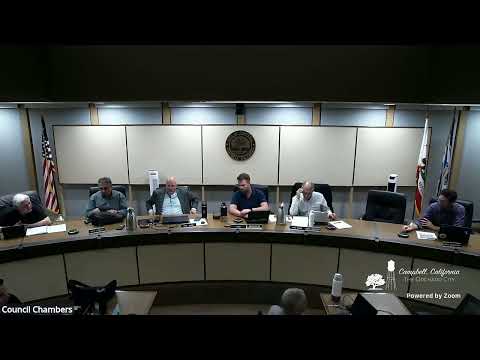
City staff and consultants presented the draft environmental impact report for the Campbell Technology Park project at the Planning Commission’s April 28 hearing, and residents and nearby industrial businesses raised repeated concerns that traffic, single‑point access and heavy‑truck operations are not fully analyzed.
Daniel Fava, the city staff presenter, opened the session by telling the commission and the public that “this is a public comment meeting on the Campbell Technology Park project's draft environmental impact report, the DEIR.” Anna Radnich, a principal planner with consultant Stantec, walked the commission through CEQA basics and the draft EIR’s findings, saying that the CEQA process exists to “identify ways to avoid, reduce, or mitigate significant environmental impacts” and that comments received during the 45‑day review will be incorporated into the final EIR.
The proposed project would redevelop the existing Campbell Technology Park (four parcels spanning about 17 acres and a roughly 280,000‑square‑foot R&D campus) into 290 housing units composed of 27 detached single‑family homes, 149 three‑story townhome‑style units and 114 four‑story townhome‑style units, the presentation said. Radnich summarized the draft EIR’s technical conclusions: biological resources and geology/soils required mitigation measures; the EIR also identifies mitigation for air quality (construction exhaust controls and HEPA maintenance for sensitive receptors), cultural and tribal resources (archaeological monitoring and training) and pedestrian improvements in the transportation chapter.
But public commenters — and several commissioners — focused on what they said the DEIR did not fully capture. Mark Rodriguez, chief financial officer and secretary of West Valley Construction Company, said his company’s operations depend on “safe, reliable, and predictable site access, including regular deliveries by large semi trucks and the ability for our crews and emergency response teams to move in and out of our facilities at all hours.” Rodriguez argued the draft EIR understates real‑world queuing, temporary roadway blockages from truck maneuvering and conflicts between heavy trucks and passenger vehicles, and he urged the city to perform a more realistic access analysis.
Chris Darmen, another West Valley Construction representative, told commissioners the company is not opposed to housing but is concerned that the DEIR’s transportation assumptions are oriented toward passenger vehicles rather than ongoing heavy‑truck operations. “We’re not opposed to the housing,” he said. “Our thing is we need to continue to do business as we have, and we’re in a zone light industrial area.” He and other business speakers urged the city to respond explicitly to their prior technical comments and to add mitigation or design changes to preserve emergency access and industrial operations.
Several residents raised similar circulation and safety worries. Susan Landry (who identified herself as a landscape architect and longtime local) said existing backups at Kirtner and McLinty and the proximity of nearby intersections mean cut‑through traffic could push cars into residential streets and pose pedestrian hazards. Natalie Strange, dialing in online, asked whether the DEIR would be revised to include a more complete analysis of queuing, cut‑through traffic, parking spillover and pedestrian safety; she urged specific, enforceable mitigation measures.
Staff and consultants repeatedly reminded the commission and public that traditional traffic congestion metrics (level of service) are generally not a CEQA consideration, though safety impacts that could increase collision risk can be. Radnich and Daniel said the DEIR models air quality impacts rather than using spot measurements and that the draft identifies mitigation measures for those impacts; they also reiterated that the document will be revised as appropriate in response to comments. The record shows the city is accepting written comments (techparkproject@campbellca.gov) and that the DEIR’s 45‑day public comment period runs through June 1.
Commissioners encouraged speakers worried about technical details to submit written, consultant‑grade analyses and asked staff to follow up on whether and how the issues raised could be incorporated into the final document. Chair Davis Fields said he would follow up with staff about when and how the commission or City Council might address traffic and circulation issues that are outside the DEIR’s legal scope.
Next procedural steps: the city will accept public comments through the publicized deadline; staff and consultants said they will address comments in the final EIR, which will return to the Planning Commission for consideration. The commission’s next scheduled meeting is May 12 at 7 p.m.