Get Full Government Meeting Transcripts, Videos, & Alerts Forever!
Get email alerts on the Special District Feasibility topic
No spam. Unsubscribe anytime.
Consultants say regional parks district could close funding gaps but governance, land and labor issues remain
Summary
Consultants presented a feasibility update showing strong public support for a regional parks and recreation special service district across Reno, Sparks and Washoe County but said detailed service-plan work is needed to resolve funding, governance, land conveyance and labor-union issues.
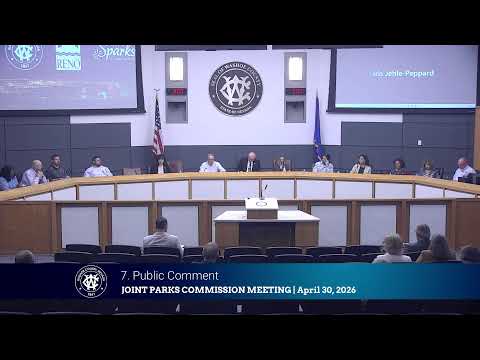
Consultants for Reno, Sparks and Washoe County told a joint parks meeting on April 30 that a regional parks and recreation special service district could help stabilize funding and equalize services across the region, but that creating the district will require months of detailed planning on governance, funding and legal issues.
"Our work is a feasibility study," Leon Younger, president of Prose Consulting, said in introducing the team's findings, adding, "There's no recommendations" at this stage; the presentation was intended to summarize data and next steps rather than to adopt policy. Younger told commissioners the team had completed stakeholder interviews, a statistically valid mailed survey and an online survey, a level-of-service analysis and an operational assessment to evaluate whether a district is feasible.
Why it matters: presenters said the region currently spends unevenly on parks and recreation, creating per-capita investment gaps that limit maintenance and services. Younger and colleagues said a single district and a dedicated funding source could provide a framework for more consistent service levels and long-term maintenance funding.
Survey and fiscal findings: the consultants reported that a statistically valid mailed survey (400 responses distributed across jurisdictions) and an online survey showed broad support for a regional approach. Younger summarized the headline numbers: about 70% of respondents said a single district could improve efficiency and service quality, and roughly two-thirds supported a dedicated funding source. The team reported per-capita investment across jurisdictions ranging from about $21 to $58, compared with a cited National Recreation and Park Association median of $77 per capita.
Funding and statutory mechanics: "There is a modern statute on the books," Andy Belknap of Baker Tilly said, referring to NRS 318A and the rules for forming parks/trails/open-space districts. Belknap described required elements for formation — a service plan, boundary and assessed valuation, descriptions of facilities and any agreements with local governments — and noted that local governments and property-owner protests can block formation. He cautioned that Nevada's limited local revenue options and property-tax caps will constrain choices and that some funding approaches would likely require voter approval.
Governance, land and labor issues: presenters emphasized the practical complexities. The statute allows initial trustees to be appointed by local governments before elections transition trustees to the ballot; the presenters said the service plan must define appointment/election timing, representation and how trustees will coordinate with city and county planning commissions. The consultants also flagged difficult but solvable issues around transferring land or facilities (fee, lease, or contractual arrangements) and harmonizing multiple collective-bargaining agreements for roughly 250 full‑time equivalents across the jurisdictions.
Next steps and options: consultants proposed a near-term workplan to build a service-plan framework in the next month and a fuller service plan with financial models and public outreach within two months. They said they plan to model at least four funding options (including, as applicable, transferring existing city/county park funding into a district and augmenting it with assessments or other permitted revenue tools) and to create governance and staffing-transition plans focused on equitable representation and protecting employees from adverse impacts.
Commissioners’ concerns and questions: members pressed presenters on how trustees would interact with existing planning commissions, whether new revenue would require voter approval, how districts would handle union contracts and whether land conveyed to a district would be encumbered by prior deed restrictions. Presenters repeatedly said many questions would be resolved in the service plan and recommended multiple working groups (land, HR/collective bargaining, finance) to handle details.
Public comment: during two public-comment periods residents including Julie Conway, Iris Peppard (Truckee River watershed coalition executive director), Mac Rossi, Tina Nappe and Karen Mullen urged commissioners to move forward, prioritize maintenance and long-term sustainability, and consider the Truckee River and regional trail system as part of planning. Peppard noted the river’s importance to the region’s water supply and ecosystems.
Votes at a glance: the three joint bodies unanimously approved the meeting agenda and later approved the City of Sparks draft minutes from June 26, 2025. No substantive policy votes on the district occurred at the session; the consultants’ report was an informational update.
The joint commission directed staff and the consultants to continue developing the service-plan framework and to return with financial scenarios, governance proposals and public-engagement milestones in the months ahead.