Get AI Briefings, Transcripts & Alerts on Local & National Government Meetings — Forever.
Methuen School Committee weighs raising class sizes, staff cuts and long-term reforms to close FY27 gap
Loading...
Summary
At an April 30 budget workshop, the Methuen School Committee considered raising class sizes to 30, cutting dozens of positions and pursuing longer-term changes—including a 'Constellations' special-education initiative and potential GIC health‑insurance changes—to close a multimillion‑dollar FY27 shortfall.
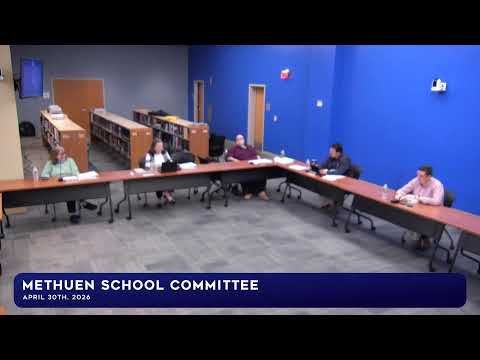
Methuen, Mass. — The Methuen School Committee met Thursday night for a budget workshop that centered on possible cuts and structural changes to close a projected FY27 funding gap, including a proposal to raise class sizes to 30, eliminate staff positions and pursue longer-term reforms.
Acting Superintendent presented the administration’s revised budget on April 30, saying central office had identified roughly $2,000,000 in additional reductions and “a net reduction of $2,300,000 from our original proposed budget.” The administration’s proposals include eliminating roughly 20 positions (including program assistants and several special-education roles) while adding a smaller set of positions, such as a CTE supervisor, a radio/TV broadcasting teacher and two float nurses.
A written public comment read at the start of the meeting amplified community concern over cuts. Kristen Maxwell, whose letter was read by the vice chair, wrote: “The problem isn't just the numbers, it's the culture,” and urged the committee to “exhaust every other option” before cutting general-education or special-education teachers.
Committee members pressed the administration for specifics and alternatives. The business office highlighted that the apparent large increase in the budget partly reflects a $3.2 million drop in state aid and earlier circuit‑breaker reimbursement differences; the business official also explained that expanding CTE enrollment can bring roughly $3,400 in Chapter 70 aid per CTE student.
Several members said raising class sizes to 30 classes could be a major line-item saver. “If we increased our class sizes to 30, we would save $1,256,000,” one member said, noting that such a move could eliminate about 16 teaching positions. Others warned that raising class sizes would be highly disruptive, could require reorganizing school spaces and still leave a large remaining deficit.
The committee discussed less disruptive approaches as well. Members proposed cutting vacant or unfilled positions and holding a small number of roles in the budget at $1 so they could be filled if state aid arrives. Administration cautioned that some lines labeled as “vacant” are currently covered by contracted services and that eliminating those lines might not produce the expected savings without also reducing contracted spending.
Beyond near‑term cuts, several members advocated for structural reforms to reduce recurring costs. Member Willett urged exploring joining the Group Insurance Commission (GIC) to lower health‑insurance spending, saying such a move could save “millions.” Others recommended pursuing a financial audit, consolidation of central services and expanded negotiations with unions to seek modest concessions as part of a broader plan to avoid layoffs.
The administration also brought forward a possible multi-year strategy called “Constellations,” intended to expand in‑district special‑education capacity and reduce costly out‑of‑district tuitions over time. Members generally supported receiving a formal proposal but emphasized that Constellations and any redistricting would be a long‑term project that would not offset this year’s shortfall.
On specific program costs, the business office described the district’s Chromebook leasing approach and estimated the most recent one‑year lease at about $105,000; stopping or reducing device leasing would reduce program continuity and access to online instructional materials, the administration said.
The workshop closed with several members urging additional outreach to unions and state officials. The mayor noted that any health‑insurance changes or state supplemental budgets could alter the local picture but cautioned that the committee should plan for the short term while pursuing longer-term reforms. The committee adjourned after brief community updates and a report that a recent high‑school job fair had been successful.
The administration is expected to present a final budget to the mayor on May 8; the committee will consider further action and votes at upcoming meetings.