Get Full Government Meeting Transcripts, Videos, & Alerts Forever!
Get email alerts on the Affordable Housing topic
No spam. Unsubscribe anytime.
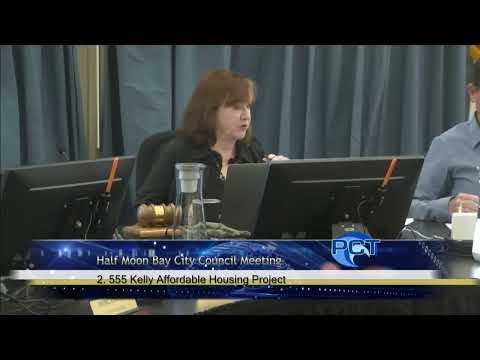
Half Moon Bay council introduces 99‑year lease for 40‑unit senior farmworker housing after hours of debate
Summary
After hours of presentations and public comment, the City Council introduced (first reading) an ordinance to approve a package of agreements for the 40‑unit 555 Kelly senior farmworker housing project, approving contract edits but leaving insurance and referendum indemnity unresolved; the motion passed 4–1.
Half Moon Bay’s City Council voted 4–1 on April 28 to introduce an ordinance that would approve the agreements underpinning the 40‑unit 555 Kelly senior farmworker housing project, including an Affordable Housing Property and Disposition Agreement (AHPDA), a 99‑year ground lease and a regulatory agreement. Vice Mayor Penrose moved the ordinance introduction; the motion was seconded and carried on a roll call vote with Council member Nagengast opposed.
The ordinance introduction follows a staff presentation from interim City Attorney Denise Pisano and the city manager outlining the AHPDA’s conditions precedent — a financing plan, a construction contract, final construction documents, a building permit and a property management agreement — and the structure of a 99‑year ground lease under which Mercy Housing would be the tenant and the city would remain landlord. Pisano said the AHPDA would govern the predevelopment period and terminate when a memorandum of ground lease is recorded.
The package staff presented would require the development to be 100% affordable and target seniors and retired agricultural workers; tenant preferences are written to prioritize Half Moon Bay senior farmworkers first, then co‑site seniors, then seniors from across San Mateo County. Pisano summarized key contract terms: affordability covenants that run long term, a $1 annual lease rent, maintenance and indemnity obligations for the developer, insurance and builder‑risk coverage during construction, and restrictions on access to certain tenant spaces unless Mercy Housing consents or a court order allows it in immigration‑enforcement cases.
The public comment period ran nearly two hours and featured more than 80 speakers. Supporters — including faith groups, local housing advocates, farmworker organizations and residents — argued the project answers a long‑standing need for dignified housing for aging farmworkers and urged the council to approve the agreements promptly. “These 40 homes have been badly needed for years,” said Noreen Cooper Hevlin of Faith in Action (speaker 27), and Evelyn Stivers of the Housing Leadership Council of San Mateo County (speaker 29) urged council members to move forward.
Opponents and skeptics raised multiple concerns. Several speakers questioned whether the site qualifies as a “major transit stop,” a status that was used to justify a density bonus and smaller parking requirements, and argued that such a finding could affect funding and legal footing. Planning commissioner Rick Hernandez (speaker 45) told the council, “All in Mercy has testified that 555 Kelly will cost approximately $1,400,000 per unit,” and warned that higher per‑unit costs reduce competitive chances for tax credits and other capital. Joaquin Jimenez (speaker 40), a longtime local resident, accused opponents of racism and criticized delays, saying the project’s opponents could be “paying for this lawsuit.”
Council members pressed staff and Mercy Housing on details during a long follow‑up discussion. Questions focused on whether the AHPDA and ground lease should include a date‑certain fallback if Mercy cannot secure the remaining capital stack and on how affordability rules would operate decades into the future. Mercy representatives said two major state funding commitments are in hand — an infill infrastructure grant and a farmworker grant — but that county funds and Low‑Income Housing Tax Credits remain to be secured and that the agreements must be in place before Mercy can apply competitively for certain public capital.
To address council concerns, staff and Mercy agreed to several contract edits the council asked be reflected in the ordinance introduction: an automatic AHPDA termination clause providing that the agreement will terminate on the earlier of the recording of the memorandum of ground lease or December 31, 2028, with a requirement that the parties meet and confer 90 days before that date if an extension is contemplated; a periodic review of the ground lease every seven years to cover insurance, operating costs, rents, the community resource space and property condition; a clearer prevailing‑wage requirement; a seven‑year records retention period and city audit right; and surrender language requiring Mercy to provide keys, passcodes and records if the lease ends. City attorney Denise Pisano summarized the settled edits before the vote.
Two issues remained unresolved at the meeting. First, council members worried the ground lease’s restoration language could leave the city with a blighted structure on its property if insurance proceeds were insufficient after a catastrophic loss (for example, a major earthquake), and asked Mercy to accept stronger remediation obligations or higher insurance limits. Mercy housing counsel said requiring unconditional developer liability for catastrophic events or mandating earthquake insurance (which Mercy said is prohibitively expensive) would render the project financially infeasible and likely unfinanceable. Second, council members asked for language protecting the city from legal exposure and costs if a citizen referendum succeeded in overturning the ordinance; Mercy said an ordinance overturned by referendum would prevent the agreements from taking effect, and Mercy declined to accept the type of indemnity the council requested.
With those unresolved items noted, the council voted to introduce the ordinance (first reading) with the agreed revisions and to bring the item back on May 5 as a regular agenda item for final adoption. The separate grant agreement authorizing the city to act as a passthrough for $2,000,000 secured by State Senator Josh Becker was continued to May 5 for separate consideration.
What’s next: the ordinance — as introduced with the edits the council approved tonight — will return on May 5 for a second reading and potential adoption. Staff and Mercy will continue to negotiate language addressing insurance and restoration, the council asked for tighter periodic‑review language placed in the ground lease itself, and the city and Mercy will continue pursuing the remaining county and tax‑credit funding needed to start construction.