Get Full Government Meeting Transcripts, Videos, & Alerts Forever!
Get email alerts on the Environment Biodiversity topic
No spam. Unsubscribe anytime.
Carpinteria Council adopts resolution to back biodiversity and climate-resilient stewardship of south-central coast
Summary
The Carpinteria City Council unanimously adopted a resolution on April 27, 2026 endorsing regional biodiversity protection and integrating native-plant and habitat measures into local planning. Supporters from regional conservation groups and local residents spoke in favor; one resident urged attention to recent tree removals at a housing site.
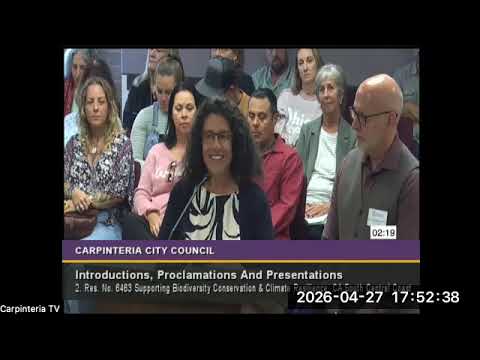
The Carpinteria City Council on April 27 adopted a resolution declaring support for biodiversity and climate-resilient stewardship of the south-central California coast, emphasizing protections for the city’s coastal, riparian and upland habitats.
The resolution, read into the record and adopted by voice vote, cites state initiatives including California’s 30-by-30 goals and calls on the city to integrate biodiversity into land-use decisions, expand protected areas and pursue restoration, partnerships and funding. The text in the record lists April 27, 2026, as the adoption date.
Supporters who addressed the council during the public-comment period urged adoption. "Wildfire prevention and biodiversity protection can complement one another," said Anne Marie Parkinson, who identified herself as executive director of a county fire-prevention council and described native-plant landscaping and slope-stabilization work that also reduces fire risk. "This resolution reflects a good balance," she said.
Stephanie Díaz, representing the Santa Barbara County Land Trust, told the council the organization has worked for four decades to protect natural and agricultural lands and welcomed the resolution’s attention to both natural and urban biodiversity. Breeze Licker, co-chair of the regional biodiversity working group, said the resolution will help protect species and habitats for future generations.
Not all public commenters focused solely on the resolution. Resident Mary Bisham urged the city to address an unrelated local development matter, saying she had filed written opposition to plans to remove 73 trees at Shepard Place and describing prior, allegedly unlawful removal of 70 trees in May 2023. "These 73 trees provided mature canopy habitat and shade," Bisham said, warning that replacement with small ornamental trees would raise local temperatures and reduce habitat for birds and pollinators.
Council members who moved the measure noted alignment with regional conservation efforts and state planning goals. The council approved the resolution by voice vote; the record does not show a roll-call tally in the transcript.
The resolution calls for the city to seek partnerships with regional agencies, tribal communities, conservation trusts and educational institutions, to identify funding sources and to return to the council with recommendations for implementation that align with state and regional plans.
Council members and conservation partners invited attendees to a group photograph after the adoption and thanked local organizations, including the botanic garden, for their role in drafting and educating the public about the measure.
Next steps in the transcript: staff and community partners were asked to follow up with implementation recommendations and potential funding sources in a future council meeting.