Get Full Government Meeting Transcripts, Videos, & Alerts Forever!
Get email alerts on the Nuisance Ordinance topic
No spam. Unsubscribe anytime.
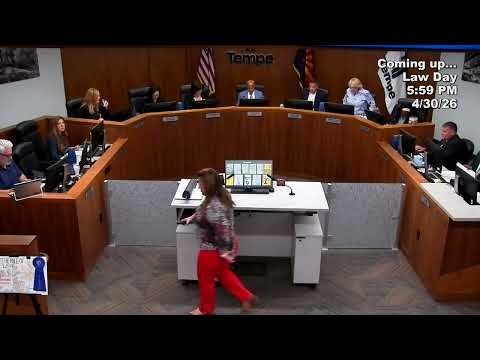
Tempe holds first hearing on nuisance ordinance after heated Daly Park testimony
Summary
Council heard wide-ranging public testimony on a draft nuisance-code amendment that would allow enforcement when recurring private distributions are linked to criminal activity; neighbors described safety and sanitation problems in Daly Park, while mutual‑aid providers warned the language is overbroad and risks criminalizing charitable aid.
Tempe’s City Council on May 1 heard the first public hearing on a proposed amendment to the nuisance code that would allow the city to treat recurring distributions on private property—food, goods or services—as a nuisance when they are tied to criminal activity that substantially interferes with neighboring property use.
City Attorney summarized the legal rationale for the amendment, saying the language mirrors court precedent and would give code-enforcement staff a clear ordinance to pursue repeat conditions that endanger neighbors or produce public-offense spillover. He described the proposed standard as conjunctive: a regular distribution plus a demonstrable tie to crime and a substantial interference with neighbors’ use of property.
Why it matters: Daly Park residents described repeated trash, drug paraphernalia, public urination, and safety incidents near ongoing food-distribution events at a nearby church and urged the council to adopt tools to protect neighborhoods. “This has created a dangerous situation … the playground is less than 250 feet from the church,” one resident testified.
Public comment was sharply divided. Daly Park neighbors and business owners documented public-safety incidents and urged stronger enforcement. Several church volunteers and mutual‑aid providers said they have worked with police and city staff and warned that the draft is written so broadly it could sweep in routine charity, potlucks or school fundraisers. “This nuisance law is just — it’s just horrific,” a mutual‑aid volunteer said, urging the council to work with providers and craft narrow, enforceable language.
Next steps and concerns: Staff said informational sessions are scheduled (including May 5 virtual/noon and 6 p.m. in‑person sessions) and the item will return for a second hearing on May 14. Legal risk and potential unintended consequences loomed large in testimony and at the dais; multiple speakers urged clearer objective thresholds and companion investments in services (restrooms, sanitation, sanctioned outreach locations) so enforcement does not simply push problems elsewhere.
The council did not vote on the ordinance on May 1; a second hearing and possible adoption are scheduled May 14, 2026.