Get AI Briefings, Transcripts & Alerts on Local & National Government Meetings — Forever.
U.S. Census Bureau webinar walks entrepreneurs through new AIES, economic data and Census Business Builder demo
Summary
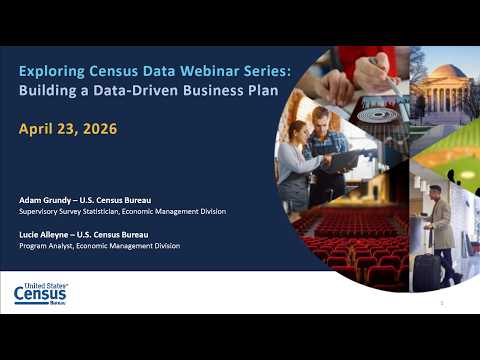
U.S. Census Bureau staff outlined how entrepreneurs can use the Economic Census, the new Annual Integrated Economic Survey (AIES), County Business Patterns and Census Business Builder to build data‑driven business plans, and answered audience questions about geographic levels and data access.
U.S. Census Bureau staff used a public webinar to summarize key business data sources and demonstrate Census Business Builder, recommending steps entrepreneurs can take to form market analyses and business plans.
Linda Lee, the webinar host, said the Census Bureau is “the federal government's largest statistical agency where we conduct over 130 surveys each year,” and walked attendees through the webinar series and how to submit questions. Lucy Aline of the bureau's Data Using Trade Outreach branch outlined the session and recommended starting data searches at the 4‑digit NAICS industry group to get a manageable, representative view of an industry.
Adam Grundy, outreach specialist and supervisory statistician in the bureau's economic directorate, described the Economic Census as “the most comprehensive economic data available,” conducted every five years and covering establishments, revenue (sales), employment and payroll. He noted the 2022 economic census added or reclassified industries (including remanufacturing and telemedicine) and produced product‑level outputs through the North American Product Classification System (NAPS).
Grundy introduced the Annual Integrated Economic Survey (AIES), a consolidation of seven prior annual surveys that the bureau sent to roughly 350,000 domestic, nonfarm employer companies. “The participation for these respondents was mandatory,” he said, adding that reported data are protected under Title 13 and Title 26 confidentiality rules. He summarized the AIES rollout timeline: an initial instrument in March 2024, a first‑look release in July 2025, a full release in February 2026 and remaining experimental products slated for April 30, 2026.
For more frequent and geographically granular measures, Grundy pointed to County Business Patterns (CBP), which publishes annual employer‑establishment statistics — uniquely down to congressional districts — and to Nonemployer Statistics for businesses without paid employees (gig workers and sole proprietors). He said the latest CBP data available during the webinar covered calendar year 2023 and that Nonemployer Statistics 2024 data were expected June 25.
Demonstrating Census Business Builder, Grundy showed attendees how to set primary and secondary variables (for example, establishments versus nonemployers), run keyword industry searches (restaurants), overlay economic and demographic data on maps, and export reports and shapefiles. He recommended zooming to the county level and using the report download or CSV export for printable outputs.
During the Q&A, Grundy advised users needing help interpreting data to contact the outreach inbox (ewd.outreach@census.gov) or AskDataCensus (AskDataCensus@census.gov) for subject‑matter follow up. He also confirmed that county business patterns supports congressional‑district queries, and that some small geographies may be suppressed if data disclosure rules require it.
The webinar closed with an invitation to a May 28 session on Longitudinal Employer‑Household Dynamics and links to the Census Academy for the recording and related resources.