Get Full Government Meeting Transcripts, Videos, & Alerts Forever!
Get email alerts on the Water Reuse topic
No spam. Unsubscribe anytime.
Agency officials explain reclaimed-water process at Rotunda treatment plant
Summary
Officials described a 2,000,000-gallon-a-day wastewater reclamation plant serving the Rotunda area, saying it treats sewage with membrane technology and returns reclaimed water for community irrigation while meeting EPA and Florida regulatory testing requirements.
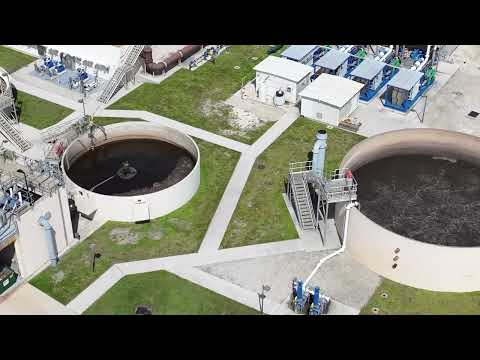
An agency presenter described operations at a 2,000,000-gallon-per-day wastewater reclamation plant that serves the Rotunda area, saying the facility treats local sewage and returns the treated water to the community for irrigation. "We treat it and we turn it into reclaim and we send it back out to the community as irrigation water," the presenter said.
The presenter said the plant does not use the standard process common at other regional facilities. "We actually use little tiny pieces of, string, almost like like spaghetti membranes," the presenter said, describing a membrane filtration system that, the speaker said, pulls water out of sewage and leaves solids behind. The presenter added that the process "actually produces the highest quality effluent that you can get outside of drinking water."
An agency official noted that the facility is regulated by both the U.S. Environmental Protection Agency and the state of Florida and must meet state drinking-water-act requirements. "We're highly regulated by both EPA and the state of Florida, so we're required to meet all state drinking water act regulations," the official said, adding that the plant conducts regular testing "to make sure that water is safe to drink and also pleasant tasting, and we can produce the quantity that we need to."
Officials said major users rely on the reclaimed water for irrigation to reduce withdrawals from the aquifer and to avoid disposal methods that could harm the environment. "It helps us dispose of it without having to use other means of disposal, which could negatively impact the environment," the presenter said.
The remarks were descriptive and did not record any formal vote or decision. Officials emphasized ongoing regulatory testing and the plant's role in local water conservation.