Get email alerts on the Multilingual Learners topic
No spam. Unsubscribe anytime.
District reports mixed multilingual‑learner progress; reclassification rates affected by state rule changes
Summary
District staff said most multilingual learners maintained or gained at least one LPAC level over the past year, but reclassification rates so far this year are lower than last year, in part because of new state guidance for students with IEPs and earlier reclassification timing in 2024‑25.
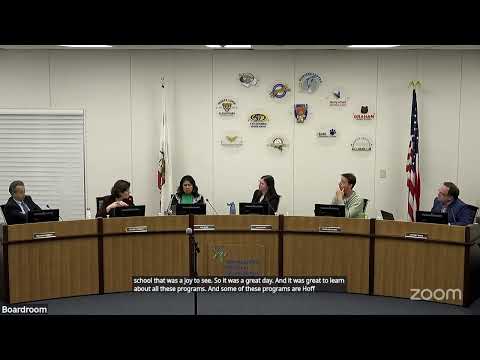
Margaret Poore, English language development teacher on special assignment, told the Mountain View Whisman School District board on April 30 that multilingual learners (MLLs) continue to show strengths but that district reclassification figures for 2025‑26 are lower so far than in prior years.
"Our multilingual learner group is very diverse," Poore said, and the district measures progress with multiple instruments including initial and summative ELPAC, interim ELPAC, district measures and CAASPP. She said LP progress — a year‑to‑year measure used to track growth toward reclassification — has hovered around 50% over the last three years and that 85% of students maintained or gained an LP level in the most recent year.
Despite that, Poore reported the district's reclassification rates as follows: 15.07% for 2023‑24, 19.68% for 2024‑25 and 12.51% so far for 2025‑26, adding the caveat that the year is not complete. She explained three main reasons for the dip: the district counted some sixth‑ and seventh‑grade reclassifications early in 2024‑25 (shifting those students into the prior year), new state guidance raising the required summative ELPAC threshold for students with IEPs from 3 to 4, and the fact that the current year’s summative ELPAC results are still pending.
"One of the reasons it's lower is that state guidance now requires students with IEPs to score a 4 on the summative ELPAC to reclassify," Poore said, noting that under the prior rule some students with IEPs had reclassified with a score of 3.
Trustees pressed staff for more disaggregated analysis. Trustee Devin Conley and others asked whether outcomes for dual‑immersion students (for example, those in the Mistral dual‑language strand) could be benchmarked against peers and whether chronic absenteeism and newcomer trajectories were being tracked. Poore said the district can provide additional cohort comparisons and finalize counts after spring LPAC/ELPAC results are available.
Board members also noted inequities in the MLL group: Poore said socioeconomically disadvantaged students, Hispanic/Latino students and students with disabilities are over‑represented among those not progressing on schedule. She said the district has identified gaps in site‑level monitoring and emphasized continued work on aligning designated ELD with core instruction, improving teacher training, and providing targeted supports for listening skills in mid‑stage learners.
Superintendent Behr thanked staff for the update and said final, normalized reclassification figures will be provided once the spring assessment results are complete. The presentation included requests from trustees for additional site‑level monitoring data, absenteeism figures by cohort and a comparison of dual‑immersion outcomes versus district peers.
The board took no action on the MLL report; staff will return with refined data and finalized reclassification numbers at a future update.
AI generated
The text on this page is AI generated. Summaries, highlights, analysis, and video transcripts are all produced from the original source material.
AI can make mistakes, so if you spot one, and we will fix it for everyone.
Note: the source content is unaltered by us. Any content source we link to, be it a video, an audio recording, or a document, is presented exactly as its publisher released it. That publisher is usually a government body, sometimes an individual official or another organisation.