Get AI Briefings, Transcripts & Alerts on Local & National Government Meetings — Forever.
Glendale commission backs neighborhood safety upgrades despite residents' parking objections
Summary
The Glendale Transportation and Parking Commission on April 27 recommended council approve targeted neighborhood safety improvements (intersection realignments, curb extensions and bike lanes) after staff's parking study showed a net loss of three on-street spaces; residents argued the study missed nights/weekends and urged more outreach.
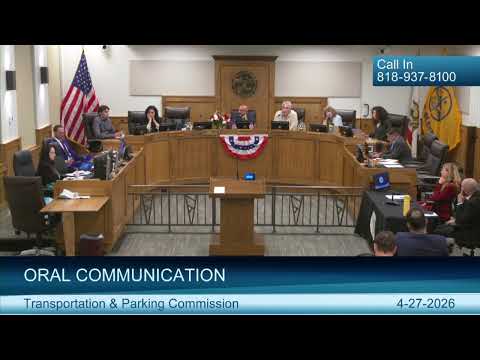
The Glendale Transportation and Parking Commission voted April 27 to recommend that the City Council approve a package of neighborhood safety improvements that includes intersection realignments, curb extensions and short stretches of new Class 2 bike lanes, even as several nearby residents urged the Commission to delay the plan because of parking loss and outreach concerns.
The recommended measures cover multiple intersections north of Glen Oaks Boulevard and adjacent to San Fernando Road; staff told commissioners the design would realign skewed intersections at Kellogg Avenue and Pelicanie Avenue, Cleveland Avenue and Glen Oaks Boulevard, and Grant Avenue and Omar Street, add curb-return extensions at Burchett Street and Pelicanie Avenue and install Class 2 bike lanes where right of way allows.
Why it matters: staff says the changes will improve driver visibility, shorten pedestrian crossing distances and reduce crash risk; nearby residents say the plan would worsen evening and weekend parking congestion and was presented to the community too late in the design process.
Staff said the parking analysis, prepared after resident concerns, found a net reduction of three on-street spaces (four would be removed and one added). "If the plan was implemented as is today, it would result in the removal of 4 parking spaces and an addition of 1 parking space," Victoria Picanhan, senior civil engineer for the Department of Public Works, told the Commission, and added the KOA study took place Friday and Saturday, Feb. 20-21, with data collected between 6 a.m. and 9 p.m.
Residents disputed those findings. "The KOA research was based on weekdays when people were at work," said Patrick Masihi, who told the Commission he had circulated petitions he said show strong neighborhood opposition and shared photos he said show full blocks on weekends. "On a weekend it's packed," Masihi said. Juan Palacios, who lives adjacent to the apartment building cited by other speakers, said a conversion to additional units removed private parking and added vehicles: "We have now more than 20 cars just from that one building alone," he said.
Commissioners pressed staff to clarify where the parking losses would occur and whether places proposed for curb extensions are already affected by daylighting (vehicle-code restrictions near intersections that prohibit parking). Picanhan said staff would confirm whether the removed stalls are currently legal parking or already constrained by daylighting; the Commission asked that those figures be explicitly disclosed to council and the public before final action.
Several commissioners said they were sympathetic to resident concerns about outreach and wanted staff to strengthen community engagement before council review. Chair Alec Bartrosov said the Commission's recommendation would move forward with two clarifying directions: require explicit disclosure to the public and council of parking impacts factoring in daylighting, and consider reassigning the Omar & Grant portion of the work to another nearby safety priority if staff finds that relocation makes sense. "We need to be explicit and clear with the public and with council about what the parking impacts are in relation to daylighting," Bartrosov said when offering his motion.
A substitute motion to reject the project as presented and require additional outreach failed for lack of a second. The chair's motion was seconded, taken to roll call and approved by majority vote.
What happens next: the Commission's recommendation will be compiled and forwarded to City Council. Staff said the project design is roughly 65–90% complete; if council approves, construction would be packaged with planned pavement rehabilitation to reduce costs and consolidate work.
Key details and context: staff reported 86 survey responses from the October 20, 2025 open house and said about 31% of respondents identified parking as a major concern. Staff also said the San Fernando Corridor Tax Share Fund will finance the work rather than outside grants. Residents and commissioners asked staff to show maps indicating precisely where the three net parking spaces would be removed and whether those on-street spaces are already noncompliant with the 20-foot daylighting rule.
The Commission's advisory recommendation does not itself authorize construction; final authority rests with the City Council, which will receive the package including the clarified parking accounting and outreach documentation.