Get AI Briefings, Transcripts & Alerts on Local & National Government Meetings — Forever.
Select committee says historic shocks and rising short-term rentals explain Harpers Ferry's long-term population decline; urges survey and blight review
Summary
A select committee told the Harpers Ferry council that historical events and a rise in short-term rentals help explain a long-running population decline and recommended a social-capital survey, a blight assessment and legal follow-up on rental options; the council did not vote on regulatory changes.
Harpers Ferry — At a special meeting April 29, a select committee presented an interim report concluding that long-term population decline in Harpers Ferry is largely linked to historical economic shocks and a recent rise in short-term rentals, and recommended further study and modest next steps.
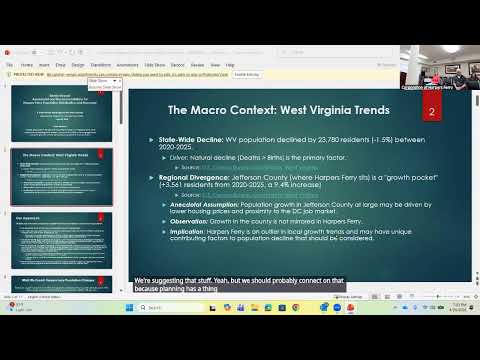
Paul Mayhew, chair of the select committee, told the Harpers Ferry Town Council the group aimed to produce “a data-driven roadmap for the town council.” The committee — Mayhew, Amanda McDaniel and Mike Rock — said they compiled historical population series, compared Harpers Ferry with nearby towns and reviewed academic literature to identify contributors to decline.
“We're just turning over rocks and reporting what we discover,” Mayhew said, summarizing the committee’s neutral approach and the work that produced the interim findings.
Mike Rock, the committee’s statistician, said the team’s regression analysis found three primary contributors: the long-ago 1924 flood and other historical shocks, the midcentury closure of a local college and a marked rise in short-term rentals. Rock reported that those three variables together explained roughly 87% of variation in Harpers Ferry’s population over the long run. “As you can see, the blue line is very close to the red line throughout,” Rock said when showing the model results.
The presenters highlighted several current data points: Harpers Ferry’s population has declined at about 1.2% per year since 1960; the committee’s review found roughly 27–30 short-term rental units in town; and about 34% of housing is owned by nonresidents, a mix of weekend homes and rental properties. Rock also said short-term rentals in the town grew at an estimated 14.8% per year since 2021, a trend the committee said could, if sustained, sharply reduce permanent residency.
Amanda McDaniel, one of the presenters, told the council that local policy choices are constrained by home rule provisions. “Home rule limits the town's ability to regulate any rental activity,” she said, noting the town’s 1% municipal sales tax generates roughly $300,000 a year and that any local rule must be written to apply to all homes, not only rentals.
Council members pressed presenters on data gaps. A council member asked whether the closure of the Hilltop House Hotel had a measurable effect on employment and residency; presenters said the hotel might account for some unexplained variation but existing data did not show a clear long-run employment impact. Presenters repeatedly recommended refreshing Lynn Pechacunas’ 2023 housing-stock study and conducting a targeted survey to clarify owners’ intentions and the split between vacation rentals, second homes and long-term rentals.
The committee proposed three near-term steps: (1) conduct a social-capital survey to measure civic engagement and factors that make Harpers Ferry livable; (2) inventory and assess blighted or uninhabited properties and options for rehabilitation or enforcement; and (3) consult with town attorney Ken Sayer (scheduled May 12) to clarify legal options under home-rule constraints. Mayhew said the social-capital approach could reveal low-cost ways to increase resident attraction without imposing regulatory burdens.
Council discussion focused on next steps rather than immediate regulatory action. Members asked to review the proposed survey questions and materials; several offered to help refine questionnaire design. The council did not take an ordinance or regulatory vote at the meeting.
Procedural actions recorded in the meeting minutes included approval of the agenda (motion by Storm, second by Christian; vote 6-0) and a motion to adjourn later in the evening that also carried 6-0. The select committee said it will return with further results after the attorney consultation and additional data collection.
The council agreed to let the committee proceed with the survey and the blight assessment and to circulate the draft survey for review ahead of the May 12 attorney meeting.