Get Full Government Meeting Transcripts, Videos, & Alerts Forever!
Get email alerts on the Intersection Safety topic
No spam. Unsubscribe anytime.
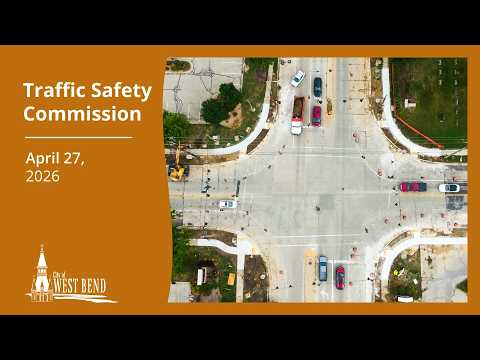
Traffic commission directs further study after consultant finds 40 crashes at Main Street and Barton Avenue
Summary
After a consultant presented a five‑year crash analysis showing 40 reported crashes and two signal‑phasing alternatives, the West Bend City Traffic Safety Commission voted to direct staff to continue studying improvements at North Main Street and Barton Avenue, including a recommended protected‑permitted left‑turn phase and consideration of a protected‑only option.
The West Bend City Traffic Safety Commission voted to direct city staff to continue studying safety improvements at the signalized intersection of North Main Street and Barton Avenue after hearing a consultant’s five‑year crash analysis.
Kevin Wayner of Veil Engineering told the commission the intersection shows a clear crash pattern involving the southeastbound left turn. “Our recommendation would be to implement alternative 1, the protected permitted, phasing,” Wayner said, explaining that phasing changes would reduce drivers’ need to judge gaps in oncoming traffic.
Wayner summarized counts and a crash history from 2020–2024: “We found that there were 40 reported crashes at the intersection,” and calculated a current crash rate of about 1.76 crashes per million entering vehicles. He presented two phasing options and cited crash‑modification factors (CMFs): protected‑permitted phasing with an estimated 17% reduction in angle crashes and protected‑only phasing with an estimated 77% reduction. Applying those factors, Wayner said the models would lower the crash rate to roughly 1.5 (protected‑permitted) or about 0.7 (protected‑only) crashes per million entering vehicles.
Doug Newman, the city’s director of public works, said the city received a vendor estimate that afternoon and that replacing the controller and adding signal heads would make the changes possible. “It’s about $25,000 to implement those changes in that intersection,” Newman said, while noting the city does not currently have budgeted funds for an unplanned $25,000 expense.
Commissioners discussed timing and costs relative to a WisDOT pavement and bridge project that currently lists the corridor for review in 2031; Newman said that project could present an opportunity to bundle signal work. After discussion the commission approved a motion (mover: Bill Schmidt; seconder: Michael Hissley) to direct the city to continue to study the intersection, consider the consultant’s alternatives and cost estimates, and report back. The motion passed by voice vote.
Why it matters: The intersection’s crash rate exceeds the threshold engineers use to flag a safety concern, and commissioners emphasized urgency to avoid additional crashes while balancing budget constraints and the potential scope of a future WisDOT reconstruction.
What’s next: City engineering staff and the traffic‑control vendor will refine cost estimates and timing, and the commission asked staff to return with implementation options that consider the 2031 WisDOT project scope. The commission noted that any formal change would require staff approval and eventual Common Council action under the commission’s advisory role (ordinance 1.52).