Get Full Government Meeting Transcripts, Videos, & Alerts Forever!
Get email alerts on the Microreactors Testbeds topic
No spam. Unsubscribe anytime.
Idaho National Laboratory outlines microreactor tests, MARVEL research unit and industry partnerships
Summary
INL technical staff described microreactor and SMR designs, safety features and testbeds, saying the DOE research microreactor MARVEL will receive fuel this summer for tests at TREAT and that lab testbeds and industry partners are being used to de-risk advanced-reactor demonstrations.
At a June briefing at Idaho National Laboratory, INL staff summarized how microreactors and small modular reactors differ from larger commercial plants and described the lab's on-site testbeds and partner demonstrations meant to mature the technologies before deployment.
Vivek Agarwal, a senior INL scientist, said advanced reactors vary by fuel and coolant and that many designs now include passive safety features and "walk-away safe" behaviors. He described microreactors as factory-fabricated, transportable units that can be delivered to remote sites, military bases or data centers and that require higher degrees of autonomy and remote operation than large plants.
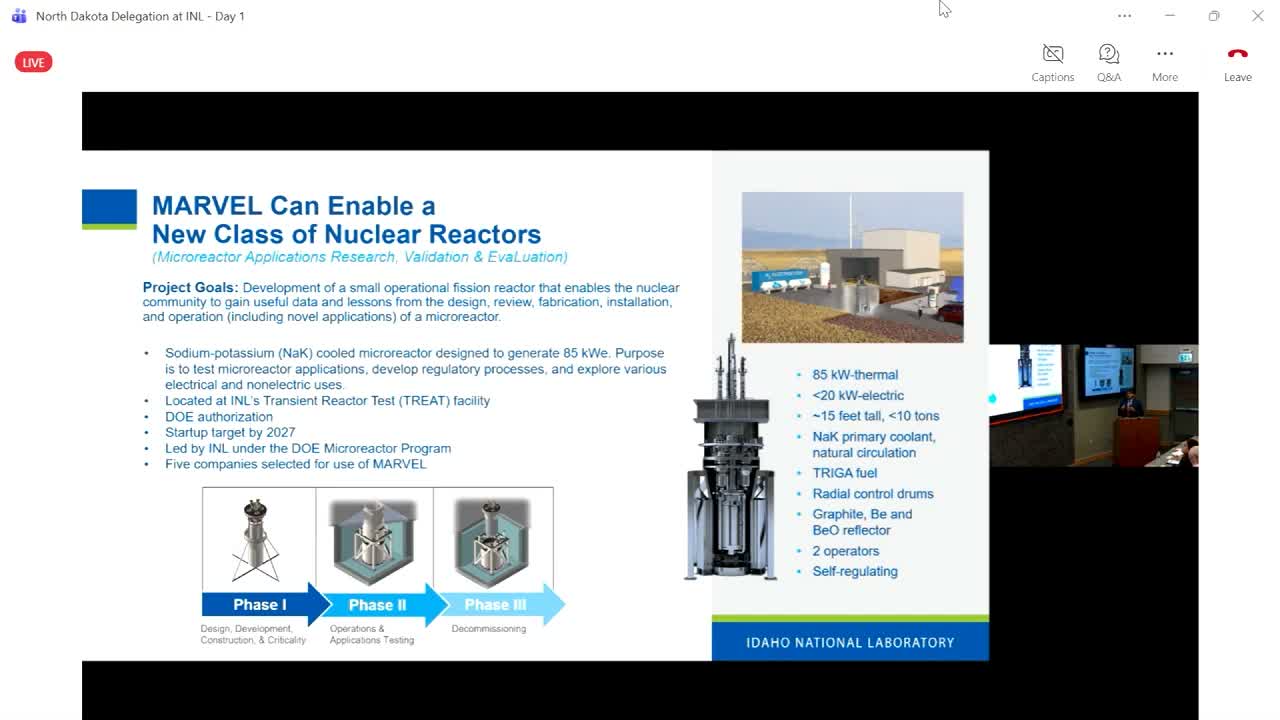
Vivek outlined INL's MARVEL research microreactor (a sodium-potassium cooled test unit of roughly 85 kilowatts electric) as a DOE research asset designed to de-risk design, instrumentation and control approaches rather than supply grid electricity. "The fuel has been fabricated. We should be receiving fuel sometime this summer, and we will be testing this in the TREAT facility," he said, adding that MARVEL's tests will inform industry partners and help validate sensors, load-following and remote-operation capabilities.
The briefing listed a series of industry collaborations and demonstration programs: ARDP-funded projects (X-energy, TerraPower), on-site private builds (Alo Atomic, Oklo), DOE pilot fuel lines, and partnerships with technology customers (AWS, Google, Microsoft) exploring data-center and process-heat applications. Vivek also cited a DOE pilot for advanced nuclear fuel lines and continued work on high-assay low-enriched uranium (HALU) contracts.
On safety and public-health questions, Vivek said advanced fuels and passive designs aim to reduce offsite risk and pointed to historical containment at past incidents. He said microreactor used fuel is smaller by mass and designed to be returned to the manufacturer or a designated facility rather than stored locally as large-reactor spent fuel.
Vivek emphasized workforce and education needs: the lab brings hundreds of interns annually and needs engineers and technicians in nuclear and adjacent disciplines to support demonstration, manufacturing and operations.
The presentation closed with a reminder that demonstrations and follow-up engineering tests are next steps; attendees then moved on to scheduled site tours.