Get Full Government Meeting Transcripts, Videos, & Alerts Forever!
Get email alerts on the Municipal Budget topic
No spam. Unsubscribe anytime.
Mayor unveils $1.04 billion FY27 budget for Springfield City
Summary
Springfield’s mayor presented a FY27 recommended budget totaling $1,038,864,570, with 83% nondiscretionary costs and a roughly $708 million schools allocation; the administration highlighted reserve health, public safety staffing, school construction with MSBA support, and submitted the plan to the city council for hearings.
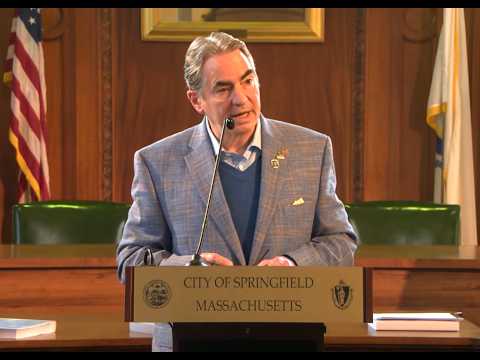
The mayor of Springfield unveiled a recommended FY27 budget the administration said totals $1,038,864,570 and submitted the plan to the city council for review and hearings. The mayor framed the proposal as fiscally prudent, emphasizing maintained services, reserve balances and investments in schools, public safety and neighborhood programs.
The mayor said the city’s finance team and award-winning reporting contributed to the plan, noting the budget “for the first time ever…is over $1,000,000,000.” He told the audience the administration closed an initial $23,700,000 gap through targeted spending reductions, vacancy management, strategic grant use and realistic revenue estimates while avoiding layoffs and major service cuts.
CFO Kathy Bunnell presented the precise FY27 recommended figure: “It is $1,038,864,570,” and said about 83% of that — roughly $862,000,000 — is nondiscretionary spending for schools, debt service, pension and benefits. Bunnell said the city’s discretionary departmental spending (the portion departments can influence) rose 2.1% to about $176,000,000 and includes negotiated cost-of-living increases.
Education accounted for the largest share of the proposal. The mayor said approximately $708–709 million — about two-thirds of the total — is school-related spending and that the school-side allocation increased by about 5.8% from FY26. He highlighted the city’s expansion of early childhood programs (full-time universal pre-K, 17 new preschool classrooms) and described multiple Mass. School Building Authority-backed projects, including White Street and Kenston Avenue combination-school initiatives.
On reserves and pensions, the mayor said the city’s reserve balance exceeds $75,000,000, and the administration has set aside about $19,300,000 for pension reserves with aggressive annual paydowns (he cited roughly $9,000,000 per year) and an internal target to substantially pay down liabilities by 2034. He noted Standard & Poor’s reaffirmed a double-A bond rating with a stable/positive outlook.
Public safety, the mayor said, remains the top priority: he reported the police force at about 514 officers with overall staffing near 559 and said negotiated contracts for rank-and-file police and firefighters have been funded. The administration highlighted investments in body-worn cameras, tasers and training, ongoing hiring and planned academies to offset attrition.
The mayor also described partnerships and programs addressing behavioral health and homelessness, including BHN clinicians who respond jointly with officers and a homelessness response program. He said Narcan distribution and response efforts have saved lives — “about 700 lives,” he said — and that behavioral health staff handle many noncriminal calls when appropriate.
Economic development and housing projects were listed as a key part of the administration’s outlook. The mayor named several private and public projects (MassMutual expansion, Union Station activity, riverfront site development, Eastfield Mall and others) and said the city has hundreds of housing units in the pipeline (he cited 378 new multifamily units and about 105 single-family units expected to sell above market rate).
The administration said ESSER funds were used for one-time school facility upgrades and that about $110,000,000 has been directed to HVAC improvements across the school system, with work continuing this summer. The budget also continues funding for health and human services, opioid-related grants, neighborhood libraries (including an announced $5,000,000 allocation for a new East Springfield library), senior meal programs and veteran services that the mayor said helped 11 formerly unhoused veterans into permanent housing.
CFO Bunnell said the city clerk will release the schedule for city council budget hearings and the council’s vote; she asked department heads to expect hearings and said the administration worked with City Council President Tracy Whitfield on scheduling. The mayor thanked department heads and staff and closed the presentation, inviting media coverage.
The city council will receive the recommended budget, hold public budget hearings on dates to be released by the city clerk, and is responsible for any final modifications or adoption.