Get AI Briefings, Transcripts & Alerts on Local & National Government Meetings — Forever.
Judge Hayward handles full traffic calendar in Clayton County State Court; mixed outcomes, several dismissals
Summary
Judge Tammy Long Hayward presided over a lengthy traffic bench calendar in Clayton County State Court on April 29, 2026. The court heard multiple bench trials, accepted several pleas and no‑pros, found several defendants guilty (including fines) and dismissed or no‑prosecuted others after officer testimony and video evidence were considered.
Judge Tammy Long Hayward opened the April 29 traffic calendar in Clayton County State Court (Courtroom 304), reminding defendants that “the state has the burden of proving the case against you beyond a reasonable doubt” and explaining options to speak with the state before a trial.
Across a busy day of bench trials and conference matters, the court accepted several prosecutor offers, granted dismissals (no‑pros) and adjudicated a string of contested cases. Prosecutor Brooks and multiple Clayton County police officers presented LIDAR speed readings, dash‑cam recordings and on‑scene observations; defendants offered contrary accounts, photographic evidence or testimony challenging the officers’ versions.
In one contested case, the court found Jeremiah Dean guilty of following too closely in a collision on Highway 138. Officer Christopher Lee testified that Dean’s black Cadillac had front‑right damage while the other vehicle had rear‑left damage; Dean testified he was in a turning lane and said the other driver moved into the lane without signaling. The judge found the officer’s observations and the damage pattern supported the charge but declined to assess a monetary fine, noting the verdict may carry points against Dean’s license and reminding him driver‑safety courses are available.
The court dismissed both cases against Jonathan LaShawn Holloway after the prosecutor offered a no‑prosecute (no‑pros). Similarly, in the Butler matter (failure to stop at a stop sign), the judge found the testimony evenly balanced after Officer Wayne Dodson and a neutral investigator testified and acquitted Dominique Butler.
The court imposed monetary penalties in several cases after finding defendants guilty: Ramon Rayner (found guilty of failing to yield when turning) received a $300 fine (total about $444 with surcharges) with 60 days to pay; Douglas Hiram Dent (improper lane change while merging onto I‑75) was fined $100 (about $153 with surcharges) with 60 days to pay; Horace A. Forbes Jr. was found guilty of speeding on Forest Parkway and fined $300 (about $444 with surcharges); Anthony Jones was found guilty of failing to stop at a three‑way stop after dash‑cam evidence was played and was fined $100 (about $153 with surcharges).
Not all LIDAR or speed allegations produced convictions. In the State’s case against Jose Santos Espinosa for a high‑speed reading on Tara Boulevard, the court paused to secure Spanish interpretation and to let Espinosa present photographic evidence about local posted speeds. After weighing the officer’s LIDAR record (63 mph recorded) together with testimony about the exact posted limit at the stop location and the LIDAR device’s margin of error, the judge concluded the prosecution had not established beyond a reasonable doubt the applicable speed zone at the precise location and entered a not‑guilty finding.
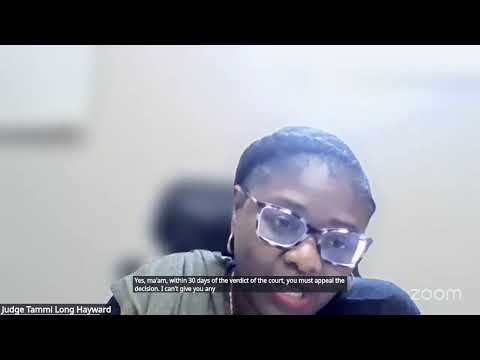
Several school‑zone speeding matters were contested. Jay Adley Munnings was found to have exceeded the school‑zone limit but the court suspended a $100 fine; Kamiki Latrice Winns was found not guilty of a license/address charge but guilty of speeding in an active school zone and given a $100 fine (about $153 with surcharges) with 60 days to pay; the judge advised defendants about appeal rights and the Department of Driver Services process for driver improvement courses, which may affect license points.
Throughout the calendar the court repeatedly advised defendants that speaking with the prosecutor before trial may resolve cases, and it scheduled numerous conferences and continuances (many to May 20, 2026). Judge Hayward closed the day with thanks to court staff on her 10th anniversary on the bench and noted continued calendars for later dates.
What happened next: fines and payment instructions are handled at the traffic‑court window on the 2nd floor (the judge consistently directed defendants to pick up paperwork before leaving). Defendants who plan to challenge convictions were reminded of the 30‑day appeal window.
Reporting notes: quotes and attributions come from the court transcript. Where LIDAR readings, fines or surcharge totals were reported in court, the articles present the amounts as stated by witnesses or the judge; several fines were reported as a base amount plus surcharges (the transcript often gives the final figure as an approximate total).