Get Full Government Meeting Transcripts, Videos, & Alerts Forever!
Get email alerts on the Municipal Utility Districts topic
No spam. Unsubscribe anytime.
Kaufman County hears two MUD petitions; court declines formal recommendation on one, approves a finding on the other
Summary
After two public hearings, Kaufman County commissioners voted to leave the decision on a proposed municipal utility district (MUD 16) to the Texas Commission on Environmental Quality, citing limited project detail and downstream drainage concerns, and registered a favorable finding for the Grand Meadows petition after developers agreed to share full creation reports with county staff.
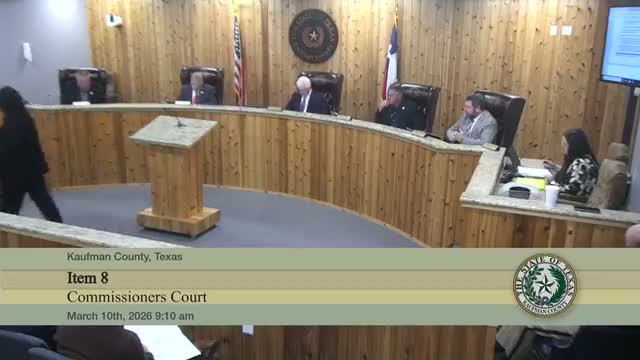
Kaufman County Commissioners Court spent the bulk of its March 10 meeting on public hearings for two proposed municipal utility districts and stopped short of a firm county endorsement for one of them.
Judge Allen opened the hearings and county counsel summarized the legal framework: MUDs are created under Chapter 54 of the Texas Water Code and the Texas Commission on Environmental Quality (TCEQ) is the final decisionmaker; the commissioners court may provide findings or a nonbinding recommendation but does not have approval authority.
A developer representative said the petition for MUD 16 covers roughly 1,856 acres owned by Bill Savage and estimated a 7-to-10-year development timeline. "I can guarantee you that when we do come up with a plan, you all will see it," the presenter said, adding that the district would be used to finance water and sewer infrastructure that could later be negotiated to city ownership.
Commissioners repeatedly pressed applicants on three themes: whether existing municipal or regional providers could supply water and sewer service, what taxes and fees residents would face inside a district, and how treated effluent and stormwater runoff would affect downstream areas. Several commissioners said they receive calls from residents worried about increased taxes and chronic downstream flooding; one commissioner warned that county tributaries and culverts already carry debris and that additional discharge could worsen flood impacts.
A field manager for a local water provider, Daniel Camille, told the court that "over 1,000 acres of that development is actually gonna be inside of our water district CCN," and asked to receive notice early so his utility can include the project in master planning. The developer said creation reports and CCN negotiations would be coordinated during the planning process and offered to file the county a full creation report.
After deliberation the court voted to take no formal county recommendation on MUD 16 and deferred the final decision to TCEQ, citing limited information available at the petition stage and ongoing downstream drainage concerns. The court did, however, direct staff and applicants to file the full creation report with county development services so commissioners can review more detailed engineering and planning documents if needed.
Kelby Golden of Onyx Development, presenting a separate petition for the Grand Meadows project, described a roughly 256-acre, high-end subdivision of about 1,100 lots adjacent to existing Meraki development. Golden said the project already holds a type-1 discharge permit and that his team has worked with county planning staff. "We view this as a partnership," Golden said, noting prior work in the county.
On the Grand Meadows petition the court voted to find the proposal would not have an unreasonable effect under the statutory criteria presented and approved forwarding the submitted findings to TCEQ. Developers and county staff agreed the county would accept and archive full creation reports and related materials to make the planning information available for commissioners and county departments.
Why it matters: The county's determinations will not bind TCEQ but are intended to supply local findings and context for the state regulator. Commissioners emphasized that, regardless of the court's choice to defer, applicants still must meet state and local engineering, drainage and environmental standards before development proceeds.
What happens next: The developers said they will file creation reports with the county's development services office; TCEQ will make the final determinations on the two petitions according to the Water Code process.