Get Full Government Meeting Transcripts, Videos, & Alerts Forever!
Get email alerts on the Tuberculosis topic
No spam. Unsubscribe anytime.
Clackamas County health officer: TB work remains central despite low U.S. rates
Summary
Dr. Sarah Preston explains why Clackamas County maintains an active tuberculosis program, describing latent infection, treatment regimens, directly observed therapy (including video verification), isolation practices and the county's typical case count of about 5 to 10 per year.
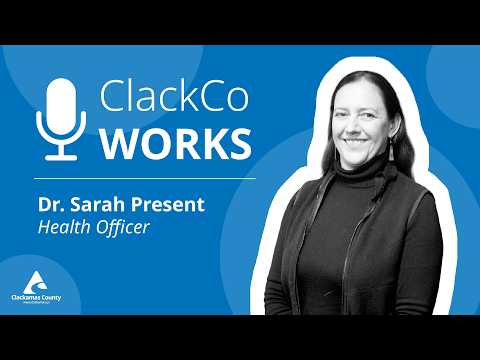
Dr. Sarah Preston, Clackamas County health officer and family physician, told Clackoworks host Dylan Blaylock that tuberculosis remains a priority for the county's infectious disease work despite its relative rarity in the United States.
Preston said TB is "one of our oldest diseases" and remains a leading cause of death globally, even though U.S. rates dropped substantially in the 20th century. She described latent tuberculosis as an infection that many people carry without symptoms that can activate later: "It's anticipated or is it, estimated that a quarter of the world is infected with tuberculosis... We're thinking about, like, 3 percent of people in The United States."
Why local focus: Preston said even though most people with latent TB never become sick, a subset will activate and require lengthy treatment. She described typical treatment as requiring multiple antibiotics over six to twelve months and explained the county's use of directly observed therapy (DOT) to ensure completion and reduce resistance: "Our tuberculosis team will watch a TB patient take their medicine every single day for that entire 6 to 9 to 12 months."
On isolation and infectiousness, Preston said patients with active pulmonary TB may be isolated during the initial one-to-two weeks while antibiotics reduce the ability to spread the bacteria. "The antibiotics decrease that spread... In the first week. First 2 weeks," she said.
Preston also described technological adaptations for DOT: the county moved from strictly in-person observation to a secure app that allows patients to record and submit videos that nurses verify, preserving privacy while maintaining adherence checks.
Local case counts: addressing how many TB patients the county sees, Preston said, "we go up and down around 5 to 10 per year." She added that the TB team's close work with patients also helps with contact investigations and with providing support—food, housing assistance, and other services—so people can complete treatment.
No new TB policy, budget or program expansion was announced during the interview. Preston framed the work as routine public-health practice aimed at preventing outbreaks and ensuring treatment completion.