Get Full Government Meeting Transcripts, Videos, & Alerts Forever!
Get email alerts on the Fire Access And Resilience topic
No spam. Unsubscribe anytime.
Laguna Beach staff urges tighter standards for fire‑access exceptions; council asks for options on thresholds and mapping pinch points
Summary
City staff proposed narrowing routine use of alternative materials-and-methods exceptions for key fire‑access features, recommending prescriptive standards for new development and triggers tied to major remodels and new lots. Councilors asked for tiered options, pipeline protections, and a prioritized inventory of constricted streets; residents urged swift action.
Laguna Beach city staff outlined a proposal to curb frequent exceptions to fire‑access requirements and to adopt clearer, citywide standards for critical emergency access features, saying piecemeal approvals have left some neighborhoods with inconsistent safety conditions.
"A substantial portion of the city's housing stock was constructed prior to the adoption of current fire safety standards," Matt Schneider, director of community development, told the council during a May study session. He said steep topography, narrow roadways and many dead‑end streets combine with high fire hazard zones to make a citywide, prescriptive approach appropriate in some cases.
Schneider framed the central policy question as whether the city should move away from routine reliance on alternative materials and methods (AM&M) variances for core access elements and toward objective standards that apply to new development and significant redevelopment. Staff identified several code elements for reform, including minimum street width, maximum street grade, dead‑end/turnaround requirements, maximum hose‑lay distances and firefighter access measures.
Why it matters: Councilors and staff said repeated, project‑by‑project exceptions can create a patchwork of conditions that fail to improve evacuation routes and response times across neighborhoods. Staff warned that relying too often on AM&Ms for core access features can preserve existing limitations rather than progressively improving the city's emergency‑access network.
Key policy points and council feedback
- Limits on AM&Ms and REPs: Schneider recommended narrowing the use of AM&Ms for core access features and restricting revocable encroachment permits (REPs) mostly to landscaping; significant right‑of‑way improvements beyond incidental landscaping could be required to be removed on major redevelopment. "This approach would help preserve facilities' ability to incrementally improve street conditions and enhance emergency access over time," he said.
- Triggers for compliance: Staff proposed that full compliance be required for new subdivisions, roadway extensions and creation of new building sites, and suggested using the city's existing 50% threshold for 'major remodel' (50% demolition or increase) as a starting trigger. Schneider said staff can return with tiered options for thresholds smaller than 50% to address borderline projects.
- On whether the fire marshal or building official should sign off: Council members asked whether residential approvals should revert to the fire marshal (commercial plans currently go through the fire department). Schneider said the current bifurcated system — building division handles single‑family and duplex permits while the fire marshal signs off on commercial — followed previous council direction; staff offered to increase consultation or move sign‑off depending on council preference.
- Examples of acceptable AM&M findings: Staff and the fire marshal said exceptions should only be granted when an alternative provides the "equivalent level of safety" — for example, an on‑site water reservoir and dedicated hose could mitigate a longer hose‑lay distance. Fire Marshal Robert Montgomery emphasized that some conditions (such as very steep grades over roughly 20%) would typically be unacceptable for an AM&M because fire apparatus cannot safely access the site.
Councilors asked staff to return with more prescriptive examples (grades/hose distances) and with legal analysis on nexus and proportionality before imposing frontage or right‑of‑way conditions on individual projects.
Public comments and community priorities
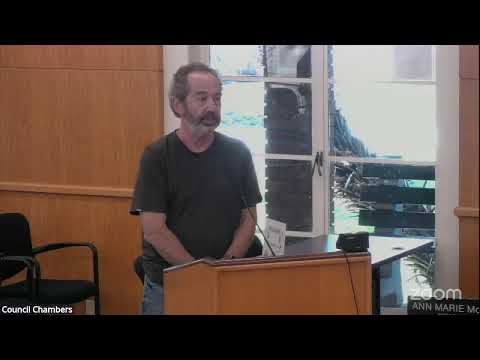
Members of the public generally supported stronger rules but raised concerns about unintended consequences. "Never met a fire regulation I didn't like," said public commenter Matt Lawson, urging an urgent, holistic approach and recommending the city update its list of access‑impaired streets (he said the list has not been revised since 1995). Landscape architect James Dockstader cautioned that if exceptions are eliminated outright, the cost of compliance could dissuade homeowners from remodeling and delay bringing nonconforming properties into safer condition; he asked for data on how many AM&M applications were filed recently.
Tom Gibbs urged targeted flexibility on small REPs but suggested limiting large retaining walls and other permanent encroachments; David Horn recommended the city leverage evac‑meeting participants to rapidly map neighborhood pinch points and prioritize limited capital improvements and short‑term fixes (for example, parking restrictions and hedge trimming).
What’s next
Councilors asked staff to bring back: tiered threshold options (less than the existing 50% major‑remodel trigger), more prescriptive examples of unacceptable conditions (grades, hose lay distances), legal analysis on nexus/proportionality for frontage requirements, a proposed timeline/pipeline protection (staff floated a 90‑day example) for projects already under review, and a plan to inventory encroachments/right‑of‑way constraints (staff noted GIS right‑of‑way layers exist but a consolidated encroachment measurement file does not).
The study session concluded with the council asking staff for refined policy options and for prioritized mapping of constrained streets; no formal motions or votes were taken. The council adjourned to closed session and will consider the policy options in future public hearings.