Get AI Briefings, Transcripts & Alerts on Local & National Government Meetings — Forever.
Laramie planning commissioners recommend West Side urban renewal plan despite floodplain and water-supply objections
Summary
On April 27, 2026, the Laramie Planning Commission voted 4–2 to recommend City Council consider Resolution 2026‑04, the West Side Urban Renewal Plan and Project, after staff and consultant presentations and lengthy public comment focused on floodplain, water and outreach concerns. Council will consider the item May 6.
The Laramie Planning Commission voted 4–2 on April 27 to recommend City Council consider Resolution 2026‑04, the West Side Urban Renewal Plan and Project, advancing the plan to a May 6 council hearing despite extensive public objections focused on floodplain risk, water supplies and outreach.
The recommendation does not itself authorize development or require a developer to use tax increment financing (TIF). Planning staff and the plan’s consultant said the designation would simply make TIF available as one possible tool if a property owner later seeks it. Mark Christiansen of AVI PC, the consultant who helped prepare the plan, told commissioners the plan "is consistent with how urban renewal has been progressing through the state" and emphasized that any TIF application and development agreement would go before City Council, not the Planning Commission.
Supporters said the plan can help incentivize needed public infrastructure. "If the streets need to be done, it should be done correctly," Brett Ralston, 29, told the commission, saying incentives could encourage developers to build with appropriate stormwater and flood protections. Commissioners also noted that the plan does not change zoning or permit development on its own and that future project‑level reviews and federal or state permitting requirements would still apply.
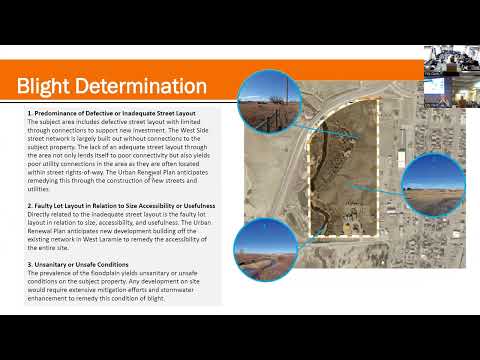
Opponents urged delay or rejection, citing floodplain, water-supply and legal concerns. A public commenter who did not provide a name called the local water situation "dire" and asked commissioners not to approve the resolution. Siobhan Kelly, a Westside resident, walked the commission through FEMA flood maps and cited the Laramie Municipal Code and the comprehensive plan’s conservation chapter, asking commissioners to take the full 30 days authorized by state law for review and to vote no. Another commenter argued that parts of the proposed area were not included in the council’s earlier blight designation and that the plan document was prepared before council had authorized the expenditure that funded it.
Commissioners debated the sufficiency of technical detail in the plan and the scale of flood‑control resources assumed in earlier materials. One commissioner asked whether rainfall patterns or a previously referenced $130 million flood control figure had changed; staff acknowledged uncertainties but reiterated that floodplain and federal permitting rules remain in force and that the designation does not exempt projects from those requirements.
Before the final recommendation, commissioners amended the resolution to correct two typographical date errors and to delete language that could be read as the Planning Commission itself "approving" the plan rather than recommending it. The amendment passed unanimously by voice vote. On roll call, the commission recorded Pacino — Aye; Bull — Nay; Moody — Aye; O'Toole — No; Schneider — Aye; Matimore — Aye. The chair announced the recommendation to forward the amended plan to City Council.
City Council is scheduled to consider the West Side Urban Renewal Plan and Project at a May 6 meeting. If council approves the plan and a future developer seeks TIF, a separate TIF application and development agreement would specify the public improvements (for example, streets, curbs and gutters, utilities, stormwater systems and site remediation) that could be funded. Commissioners and staff said those elements will be defined at the project stage and remain subject to code, federal and state permitting.