Get AI Briefings, Transcripts & Alerts on Local & National Government Meetings — Forever.
Senate panel advances MAP Act language into supplemental vehicle; reporting amendment fails after AG and MFCU testimony
Summary
Senate Finance committee laid over the MAP Act language into the supplemental budget vehicle (A54) and rejected an amendment (A65) that would have required annual reporting by the Attorney General. The committee heard testimony from MFCU director Nick Wonka and Attorney General Ellison that the requested information is already publicly reported and raised concerns about calendar-year vs. federal fiscal-year accounting.
The Senate Finance Committee on April 29 moved language from Senate File 2689 — the Medical Assistant Protection (MAP) Act — into the omnibus supplemental vehicle but voted down a related reporting amendment after hours of debate and testimony.
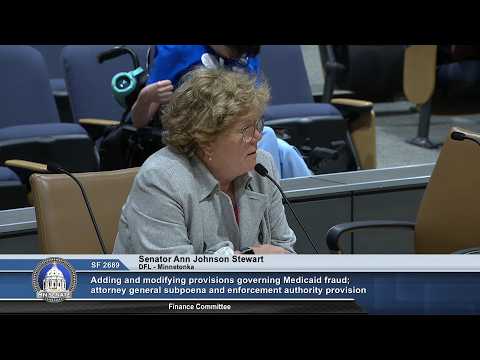
Senator Johnson Stewart, the bill’s chief sponsor, described the MAP Act as bipartisan legislation to expand the Attorney General’s authority to investigate fraud against Minnesota’s Medical Assistance program. "If passed this bill will increase the Medicaid Fraud Control Unit staff from 32 to 50," she told the committee, listing proposed staffing additions including investigators, three attorneys and four support staff.
Committee staff summarized the fiscal note: the Attorney General’s Office flagged a requirement of $1,231,000 beginning in fiscal year 2027 with ongoing tails to support additional staff; the Department of Human Services flagged an additional documentation-processing cost (described as $85,000 in FY27 and $100,000 ongoing) that the chair said the committee preferred not to include in the bill.
Senator Draheim offered Amendment A65 to require the office to report annually to chairs and ranking minority members on the MFCU’s budget, accounting for spending "in the preceding federal fiscal year," cases referred, investigations and dispositions, and to require the "office of the attorney general" to present the material in person if a committee requested it. Nick Wonka, the MFCU director, testified that the unit already files annual, public reports with the U.S. Department of Health and Human Services Office of Inspector General and cautioned that the amendment’s original calendar‑year budgeting language would misalign with the unit’s federal fiscal‑year accounting. "Our reports to HHS OIG are public," Wonka said, adding that federal reports include staffing, budgets, convictions and recoveries for all states.
Attorney General Ellison told the committee the amendment would be "unnecessary and duplicative" given existing federal and state reporting (he cited an "8.15" report and a false-claims report) and objected to language that would have required him personally to appear. Supporters of A65, including Senators Draheim and Pratt, said a legislative reporting requirement would provide additional transparency about new state funding and how effectively FTEs are used. After staff restated an orally amended version of A65 (inserting "preceding federal fiscal year" and requiring the "office of the attorney general" to present), the committee took a roll call: A65 failed, with 5 ayes and 7 nays.
The committee laid the MAP Act language into House File 2433 through an A54 amendment (which omits appropriations already represented in the state government article) and left the supplemental vehicle on the table for further consideration.