Get Full Government Meeting Transcripts, Videos, & Alerts Forever!
Get email alerts on the Emergency Services topic
No spam. Unsubscribe anytime.
Fire chiefs and ESD leaders tell Hays County proposed CECC fees would strain small emergency districts
Summary
Representatives of Hays County Emergency Services District No. 5 and the Hays County Fire Chiefs Association warned commissioners that proposed Combined Emergency Communication Center fees would hit limited‑revenue ESDs hard and asked the court to meet with ESD partners to find alternatives, including county coverage of dispatch costs.
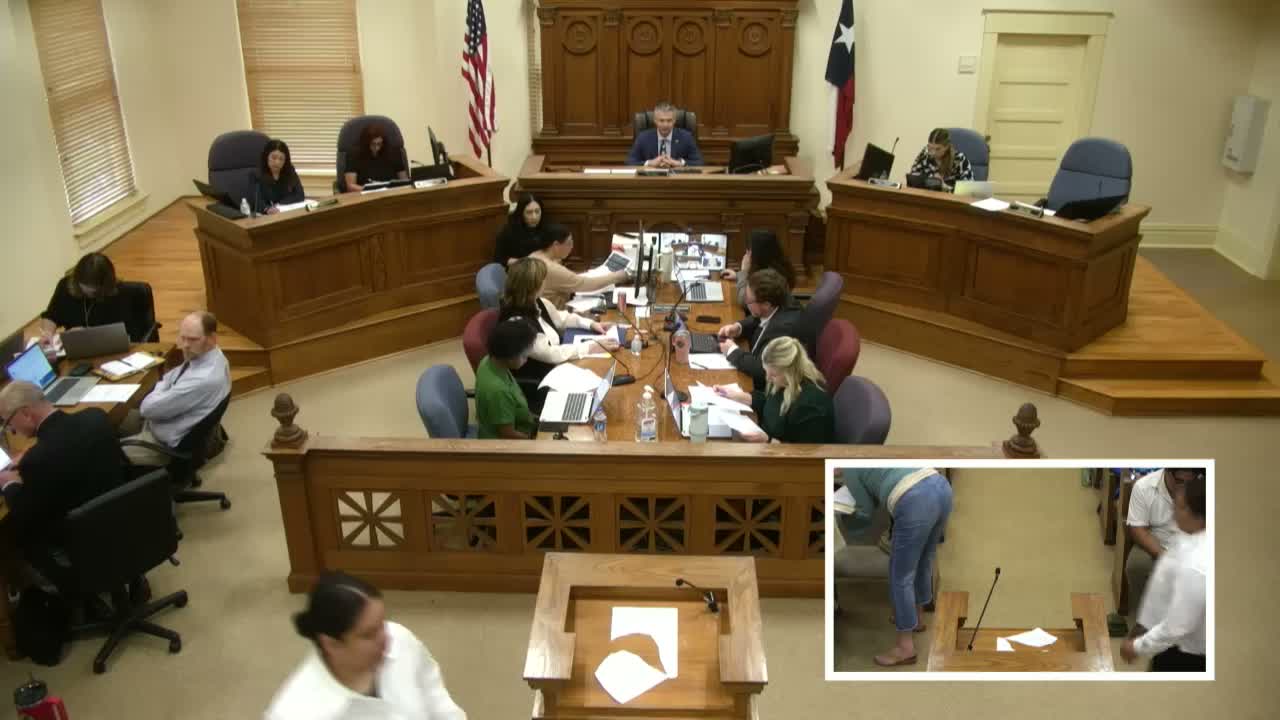
Leaders of local emergency services urged Hays County’s commissioners on April 16 to address proposed Combined Emergency Communication Center (CECC) fees that they say would materially strain small Emergency Services Districts (ESDs) that are already capped at a 10¢ tax rate per $100 valuation.
Freddie Rolland (who introduced himself to the court and identified his role with Hays County ESD No. 5 and the Hays County Fire Chiefs Association) described rising costs: payroll increases, insurance, pensions, personal protective equipment and operational expenses. He said call volume has risen (7,200 calls last year; projected near 8,000 this year) and that adding CECC fees “heavily impact[s] how we can move forward and how we can keep up with the needs of our community.” He asked the court to convene a meeting with the judge, commissioners and ESD partners to seek solutions.
Susan Mekel, also representing Hays County Emergency Services District No. 5, explained ESDs’ limited revenue tools and caps. She told the court that ESDs are limited to a 10¢ cap per $100 valuation and are already constrained by a 3.5% annual increase limit under state law; as a result, shifting CECC costs to ESDs could force them to delay firefighter hires and reduce operational capacity. Mekel suggested two options: the county continue to fund a one‑cent county subsidy that would cover the CECC request (estimated at $1.5 million) or the county facilitate a coordinated budgeting meeting so ESDs and the county can identify feasible cost‑sharing approaches.
The court responded by inviting ESD commissioners and department leaders to a meeting. County staff and commissioners asked for more detailed fiscal analysis, and one commissioner noted the county budget office could evaluate whether a one‑cent county levy could offset the CECC request.
No formal vote was taken at the meeting. The ESD leaders said they would follow up to schedule a meeting with county leadership.