Get Full Government Meeting Transcripts, Videos, & Alerts Forever!
Get email alerts on the Development Review topic
No spam. Unsubscribe anytime.
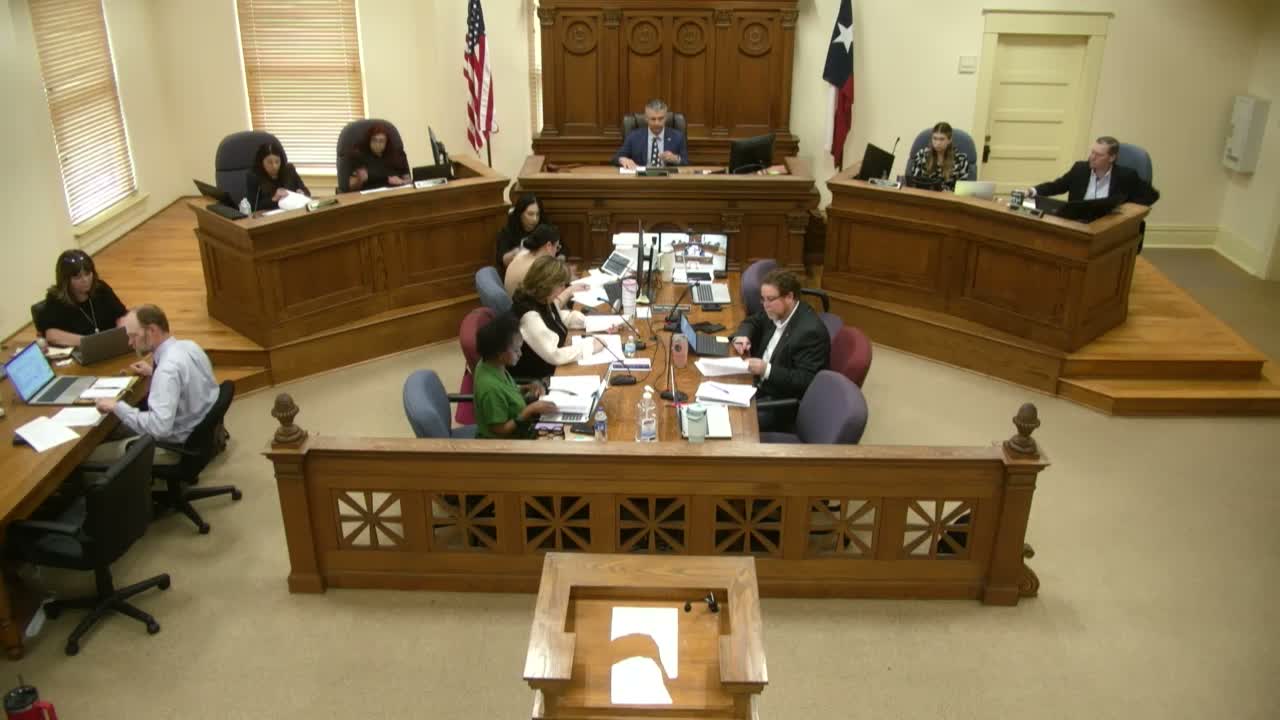
Hays County gives staff direction to draft high‑intensity development review plan amid water and authority concerns
Summary
After public comments and extended debate about water availability and legal authority, Hays County commissioners directed staff to draft a plan and budget proposal to create a “high‑intensity development review” function inside Development Services, but took no recorded roll‑call vote on final approval.
Hays County Commissioners Court on April 16 directed county staff to prepare a proposal and budget materials for a new high‑intensity development review function inside Development Services, a move framed by the court as preparatory rather than immediately budgetary.
The agenda item—introduced as an effort to prepare the county to review large single‑user industrial projects and other developments with heavy water or energy demands—prompted lengthy public comment and a sustained exchange among commissioners over whether the county has statutory authority to treat some projects differently.
Supporters said the step is about readiness. A written public comment submitted by Kenneth Rocha cautioned that specialized review divisions have, elsewhere, evolved into de facto zoning tools and warned of fiscal and legal risks if the county added permanent staff without clear authority. The court sponsor repeatedly described the initiative as designed to be “no cost” at the outset, saying the county would first seek to use existing staff and, only if necessary, recover outside‑review costs from applicants.
Opponents pressed legal and procedural limits. Commissioner Smith urged caution, saying counties have only the powers the state grants and that the court should not assume new regulatory authority absent state law changes: “We only have authority that is specifically given to us by the state,” he said during the debate. Smith and others recommended routing technical reviews through groundwater conservation districts and waiting for clearer statutory authority before creating enforceable requirements.
The court did not record a roll‑call vote on a final ordinance or appropriation. Instead, commissioners voted to give the county administrator and budget staff direction to work with Development Services, HR and legal to produce job descriptions, a fiscal impact estimate and a proposed structure for inclusion in the FY2027 budget process. County Administrator Candace Butte said she will coordinate with legal, HR and the budget office on recommendations and return with specifics.
Planning staff and the civil attorney’s office described a complex statutory landscape. Assistant civil counsel Chase Young summarized the interaction of state statute, county rules and state technical forms, saying the existing mix of state law and local regulation has created “odd idiosyncrasies” in how minimum lot‑size and groundwater availability requirements apply across groundwater management zones. He urged a careful administrative approach to avoid unintended consequences.
Next steps: staff will draft a proposed job description and budget language, coordinate submission of groundwater availability forms to the appropriate groundwater conservation district when applications require them, and present concrete recommendations to the court as part of the FY2027 budget calendar.