Get Full Government Meeting Transcripts, Videos, & Alerts Forever!
Get email alerts on the Data Centers topic
No spam. Unsubscribe anytime.
Grayson County court adopts resolution urging state review, citing water, power and noise concerns
Summary
After an extended public-comment period, the Grayson County Commissioners Court on March 17 approved a resolution asking the Texas Legislature to require independent impact studies and give counties more say over large data centers and battery storage projects, citing local concerns about water, electricity, noise and property values.
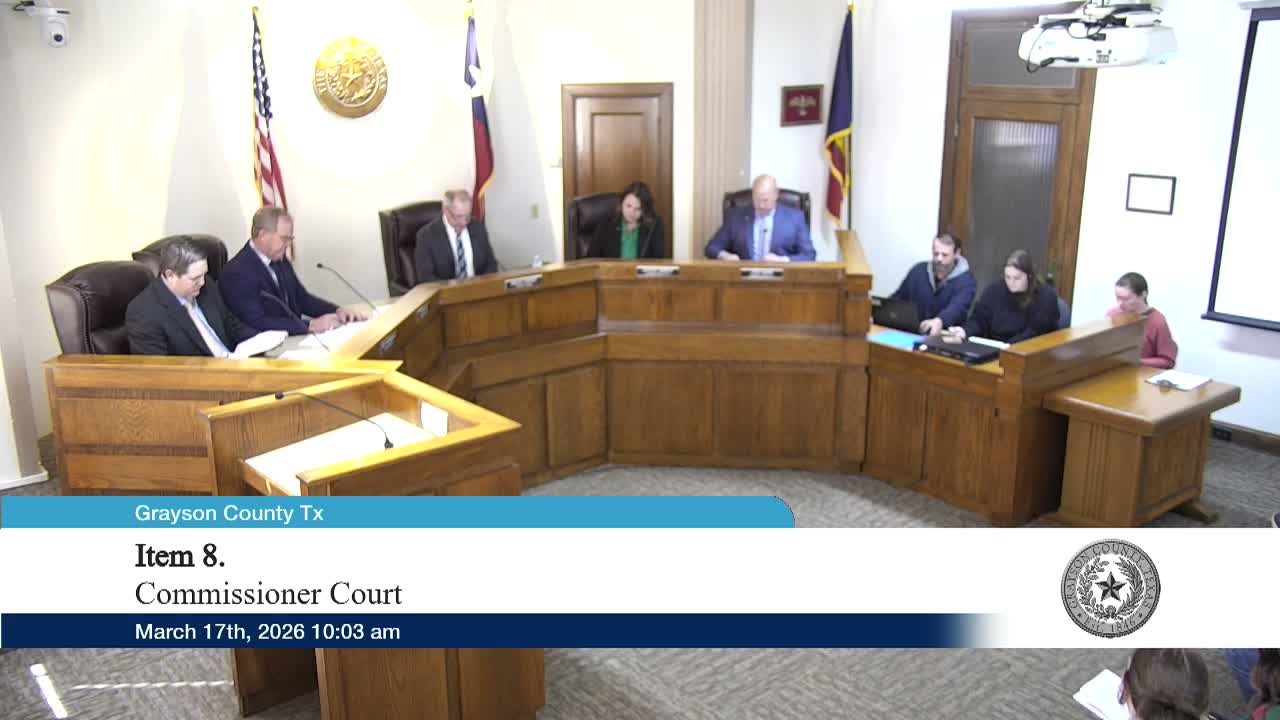
The Grayson County Commissioners Court on March 17 approved a resolution asking the Texas Legislature and governor to require independent impact assessments and consider giving counties greater authority over the siting of large data centers and battery-storage facilities.
The court’s action followed more than an hour of public comment from residents, farmers and small-business owners worried about strain on the electric grid and rural water systems, persistent industrial noise, the risk of fires at lithium-battery facilities and declines in nearby property values. The resolution asks state policymakers to study impacts on ERCOT and grid reliability, regional water availability and drought planning, agricultural land and wildlife habitat, and long-term infrastructure costs borne by taxpayers.
"We do have concerns whether on the power," said resident Eugene Cover, who spoke to the court about existing outages and his belief that an additional large electric draw would affect local service. Lauren Wilson, whose home is near a proposed site in Bells, told the court the project would be "within a mile of the elementary, middle and high school," raising worries about construction disruptions and increased traffic. Heather Dischner, a local business owner, said a nearby battery facility has produced a constant "humming" and occasional loud spikes that have affected bees, livestock and property use.
A resident who supported the resolution, Mason McAllister, urged transparency and safeguards, saying the community deserves "a meaningful voice" over projects that could affect water supply, the electric grid and farmland. Jet Parker, another commenter, cited figures he said are typical for large facilities — "300,000 to 500,000 gallons of water per day" for cooling and an electrical draw comparable to tens of thousands of homes — and warned of continuous low-frequency noise from chillers and backup generators.
Court discussion emphasized the limits of county authority under current Texas law. A county official summarized recent attorney‑general opinions and constitutional constraints that leave counties with little zoning power outside certain lake areas and no clear independent ability to deny a data center simply on its classification. Commissioners said the resolution is intended to spur state-level review and to request tools such as mandatory independent impact assessments and clearer local participation in infrastructure planning.
A commissioner moved to approve the resolution "as is"; the court approved it by voice vote, with members answering "Aye" and the presiding officer declaring the motion carried. The judge said the court would sign the resolution and pursue state engagement, and encouraged residents to testify in Austin when hearings occur.
The resolution calls for a special session or interim hearings if circumstances warrant, and requests that no future data‑center project proceed without rigorous independent review of grid reliability, transmission capacity, water availability and long-term infrastructure impacts. The signed resolution will be transmitted to the governor and the state legislature, according to the court.
The court’s action does not itself change local land-use law; several commissioners reiterated that state legislation would be required to expand county authority. The court encouraged residents to contact state representatives and senators and to participate in any future hearings.
The court moved to the remainder of the agenda after the vote.