Get Full Government Meeting Transcripts, Videos, & Alerts Forever!
Get email alerts on the Vision Clearance topic
No spam. Unsubscribe anytime.
Neighbors contest church's request to eliminate vision‑clearance triangle for 6‑ft fence at 42 E. Tompkins
Summary
At a contested hearing, Global Community Church sought variances to enclose a grass area with a six‑foot ornamental fence; neighbors cited child‑safety and visibility concerns while traffic staff said sight lines are preserved given the one‑way street geometry.
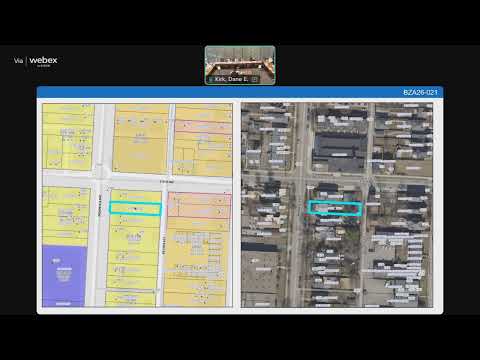
The most contested item at the April 28 Columbus Board of Zoning Adjustment meeting was BZA25‑134, an application by Global Community Church to install a six‑foot ornamental metal fence and reduce two vision‑clearance triangles at the intersection of East Tompkins Street and East Avenue.
Attorney Laura Komack introduced the application and said the church pivoted from an earlier plan because of construction constraints, proposing a flat grass yard enclosed by an ornamental fence "to keep that area completely safe" for children and church members. Witness Sarai Ramirez said the enclosure addresses children who play on site and concerns about vandalism and encampments near the church.
Division of Traffic Management staff walked the board through sight‑line measurements and noted East Tompkins is one‑way westbound; the staff witness said the proposed fence line would sit well within the right‑of‑way geometry and "there should not be any obstruction of necessary sight lines based on the fence." Daniel Ma, an environmental engineer and church member who assisted on the project, said the fence would be set back about a foot from the proposed fence line to the existing sidewalk and that between the proposed fence and the curb there is about 16–17 feet of clear vision.
Neighbors pressed two lines of objection. Kathy Kramer, identifying herself as a long‑term renter across the street, said eliminating the 30×30 triangle "is not a reduction — it's a complete elimination of a safety requirement" and argued the church had not shown a unique practical difficulty warranting the change. Other residents — including a neighbor who said his car was once stolen from adjacent gravel and long‑time residents who said they worried about the 6‑ft height in the residential streetscape — spoke in opposition, citing pedestrian and child safety at a nearby school bus stop.
Church representatives and other neighbors countered by describing property‑crime and safety incidents, and multiple neighborhood speakers said they supported the fence as a security measure to protect children and church events. The church noted the fence would be 30% opaque (70%+ transparent) and that they would not park cars inside the enclosed area.
After deliberation the board found the Dunkin factors satisfied in this instance — relying in part on the Division of Traffic Management's testimony about sight lines and the one‑way street alignment — and approved the requested vision‑clearance variances. The board recorded the roll call and set conditions tied to standard permit review.
What was said (representative quotes): • "We are a church... we'd like to kinda close enclose that specific area due to the safety of the children." — Sarai Ramirez (parishioner) • "This is not a reduction. It's a complete elimination of a safety requirement." — Kathy Kramer (neighbor) • "There should not be any obstruction of necessary sight lines based on the fence." — Division of Traffic Management representative
Next steps: The church must apply for permits consistent with the approved variance, and staff will review the submitted fence details during permitting to confirm opacity, setbacks and construction match the board's approvals.
Context note: The hearing included extensive neighborhood testimony on both sides; the board relied on staff sight‑line measurements and the one‑way traffic geometry when making its finding on safety and visibility.