Get AI Briefings, Transcripts & Alerts on Local & National Government Meetings — Forever.
State, federal and local partners break ground in Moab on trail connection project
Summary
Officials from the Utah Department of Transportation, the governor's office, the Bureau of Land Management and local leaders marked the groundbreaking for a project to link existing trails into a statewide active‑transportation network, citing safety, tourism and long‑term legislative funding.
Carlos Braceras, representing the Utah Department of Transportation, opened a groundbreaking ceremony in Moab on a project intended to connect existing trails across Utah into a single active‑transportation network and thanked Whitaker Construction and multiple public partners for their roles.
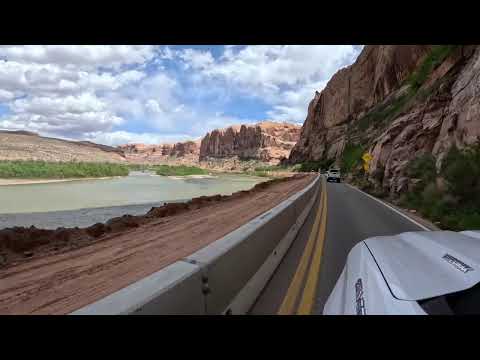
"We're doing the groundbreaking for a project...that was too hard to get to for so many years," Braceras said, calling the effort the start of a multi‑decade program to extend and link trails statewide. He told the assembled officials and community members the project addresses a formerly "sketchy" route riders used to reach town and that the plan envisions ongoing work similar to road and transit planning.
Governor Spencer Cox framed the project as part of a broader push to make Utah a national leader in active transportation. "Thirty thousand people use this trail every year and end up in a place where they can't get into town, and we wanna fix that," he said, urging continued legislative support for what he described as a long‑term vision that will benefit residents and visitors.
Jennifer Jones, introduced as an assistant field manager for the Bureau of Land Management, highlighted the corridor's designations — the Upper Colorado River scenic byway and the Dinosaur Diamond scenic byway — and emphasized the pathway's accessibility. "This paved multimodal pathway is available to people of all types and all abilities," she said, and noted the Moab area receives roughly 2,000,000 visitors annually.
Jason Curry, director of the Utah Division of Outdoor Recreation, praised the interagency partnership and said the project pairs scenic destinations with safer, more usable connections for residents and tourists. "It's not about the destination, it's about the journey," Curry said, describing coordination between state, federal and local trail teams.
Grand County Commissioner Bill Winfield recounted the long local history and said the trail work will link areas from Burrell Pass to downtown Moab, and eventually improve connections to Spanish Valley and Mud Springs. "We're gonna be able to finally have some connectivity that will start somewhere at the top of Burrell Pass and be able to go all the way to the Mayor's Office in Downtown Moab," Winfield said.
In a brief question period, officials said the trail effort is part of an ongoing program rather than a single project, with a roughly 20‑year buildout envisioned and continued legislative funding expected to support future phases. Gov. Cox also addressed broader regional matters raised by attendees, saying recent talks with other governors and the U.S. Department of the Interior were focused on cooperation around Colorado River operations amid drought; he cited an agreement to limit releases from Lake Powell as an important recent development for state water managers.
The ceremony concluded with plans for a short celebratory bike ride on portions of the corridor and informal briefings for media and partners. No formal votes or regulatory actions were taken at the event; officials described this as a ceremonial groundbreaking and a public announcement of the program's next phase.