Get AI Briefings, Transcripts & Alerts on Local & National Government Meetings — Forever.
Urbana community meeting reviews LEAP plan for unarmed community responders; residents and council press for funding, coordination and equity safeguards
Summary
LEAP consultants described a community responder model for Urbana, citing call‑narrative analysis that found conflict resolution, mental‑health and service‑connection calls as primary candidates. Residents and elected officials pressed for clarity on costs, Metcad coordination, equity protections and linkages to social services.
LEAP consultants and City of Urbana staff presented an overview of community responder programs and the task force’s analysis at a public engagement session, and residents, township and council representatives raised questions about funding, dispatch coordination and equity safeguards.
Deonte “Dee” Martin of LEAP told the roughly two‑dozen attendees that LEAP is a nonprofit that helps cities design community responder programs and that the group analyzed Urbana’s 911 call narratives to identify which low‑risk calls could be handled by trained, unarmed responders. “We are a nonprofit organization … and we work with cities to design community responder programs,” Dee said, explaining examples from Dayton, Evanston and Durham as models Urbana might adapt.
Why it matters: city staff and LEAP are building a program intended to divert lower‑risk 911 calls away from police to responders trained in de‑escalation, mediation and service‑connection. LEAP presented the task force’s categorization of Urbana calls and the approximate share falling into each category: conflict resolution about 58.2%, mental health about 17.9%, service connection about 10.7%, substance use about 5.5%, medical about 0.6% and basic assistance about 7.1%.
During public comment, residents asked operational questions about response time, who can call the service, staffing and whether responders would be volunteers or paid. Rich Castle asked whether responders would be “just residents that sign up and get trained” and how shifts and dispatch would work; Dee replied that responders would be paid (not volunteers), typically operate as two‑person teams, and that hours and shift lengths would be set based on eligible call volume and local needs.
Budget and resources: City Council member Chris Evans warned that implementing a staffed responder program would require “real costs” — staffing, supplies and vehicles — and asked where revenue would come from given local resistance to new taxes. Several commenters, including Cunningham Township supervisor Danielle, urged that a response program be tightly integrated with concrete resource pathways (shelters, drop‑in centers, detox and other services) so encounters lead to lasting help rather than a single outreach contact.
Coordination and dispatch: multiple speakers emphasized the need to integrate protocols with Metcad (Urbana/Champaign 911 dispatch), the University of Illinois and neighboring jurisdictions to avoid fragmentation. Tracy Parsons asked whether common terminology and dispatch triggers could be aligned across local systems; LEAP said it has been working with Metcad and other partners to draft compatible protocols.
Equity concerns: Danielle and other speakers warned against creating a two‑tiered system that would route some communities into diversion while others receive policing. They urged explicit design features to examine and prevent racial, gender and class disparities in who gets the community responder option.
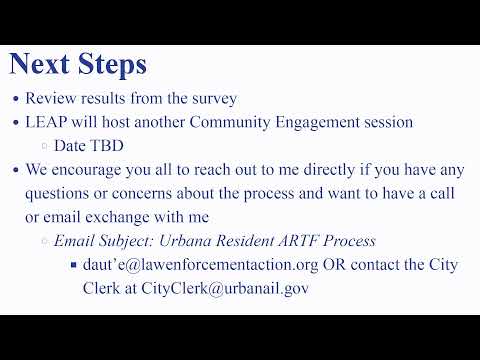
Next steps: LEAP and city staff urged attendees to fill out the online survey (QR code provided) and said the task force will review survey responses, continue stakeholder conversations and host another community engagement session (city staff announced a task force meeting scheduled for June 11, 03:30–05:30 at the India Center). LEAP said it will produce a report recommending responder types, operating hours, housing agency and other programmatic details for the city to consider.
The session closed after staff noted the presentation and earlier task force meetings are posted on the city website and video playback will be available on UPTV’s YouTube channel. The task force has completed six of eight meetings to date; LEAP said it will finalize recommendations after community and stakeholder input.