Get Full Government Meeting Transcripts, Videos, & Alerts Forever!
Get email alerts on the Food Security topic
No spam. Unsubscribe anytime.
Alachua County outlines food-system resilience plan and small-farmer supports after storm losses
Summary
Alachua County staff described efforts to strengthen the local food system — from small-farmer grants and business-planning support to a proposed food hub and resilience hubs — and addressed commissioner concerns about food loss and distribution after recent storms.
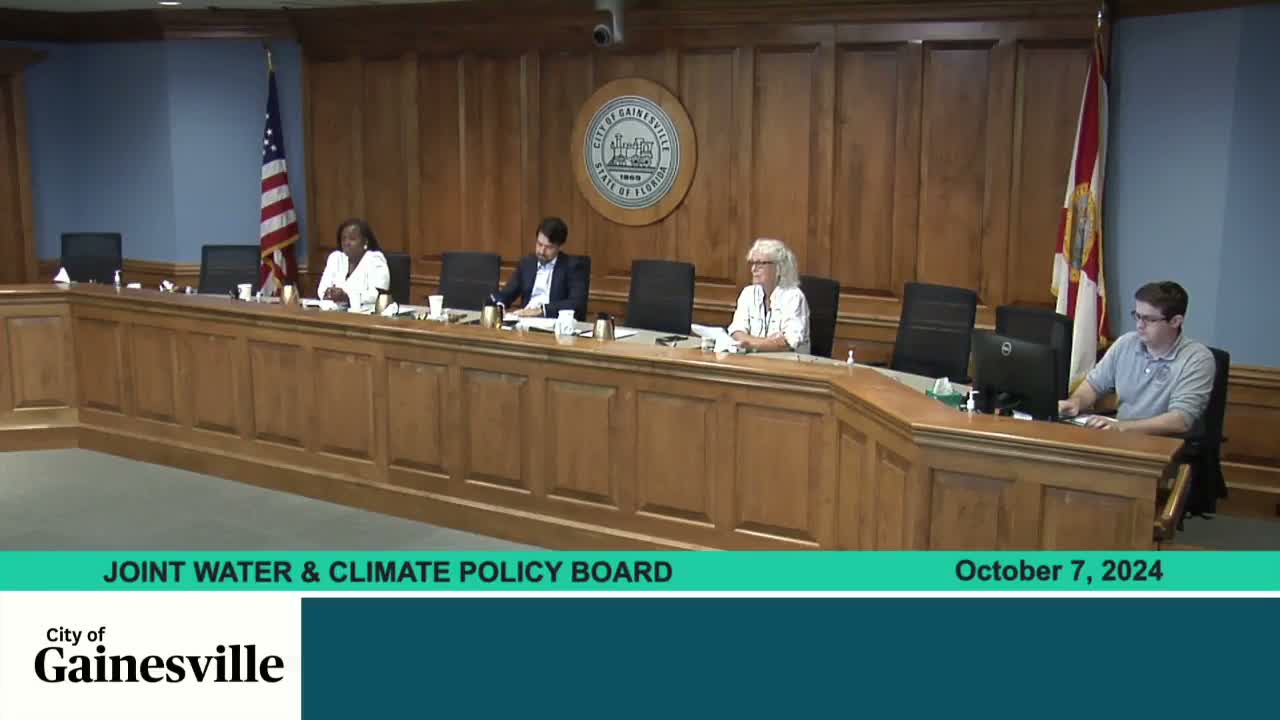
Sean McClendon, the county’s economic development manager, told the joint Water and Climate Policy Board that Alachua County is expanding programs to shore up the local food system after repeated storm losses to agriculture.
McClendon defined a food system as everything from production and aggregation to distribution and consumption, and said that recent hurricanes have caused large agricultural losses in Florida. "Ian had a $1,300,000,000 impact on our agricultural systems here alone in the state of Florida," he said, and noted similar, smaller impacts from 2023 and 2024 storms. He said the county is focusing on reducing waste, supporting small producers and building distribution capacity.
County staff highlighted the small-farmer grant program, now in its third year, as a practical step to keep small operations viable. "We had 28 total applications that were approved and it affords grant opportunities of up to $5,000 for capital expenses," McClendon said, noting that 100% of awardees met equity priorities, 96% are very small farms and 86% were first-time applicants. He said the median farm size in Alachua County is about 22 acres and that many applicants need modest equipment, fencing or small refrigeration units.
Commissioners pushed staff to make the grant recipient list public and to broaden outreach. Commissioner Hunter Walker said a local farmer had approached her about opening an East Gainesville grocery and asked whether the county publishes grantee names; McClendon said the county published the list when the commission approved awards and that the GAP program has been extended for FY25 with applications expected to open around January–February.
Board members and staff also discussed business-planning and incubation supports intended to help producers move into retail markets. McClendon said the county funds a three-step farm-plan curriculum through the Extension office and partners with Working Food, a local commercial kitchen, to subsidize kitchen and freezer space and help producers develop food-safety and marketing plans.
On distribution and disaster response, members asked how to prevent food losses during power outages and how to get food to affected residents. McClendon pointed to schools’ role during COVID as a model, and said the county is preparing a services contract to begin a 30-month investigation into establishing a food hub that would provide aggregation, processing and cold-storage capacity for institutional purchasers. "Hopefully, on October 22, the County Commission's next Board meeting, the services contract will come back. We will begin that 30-month investigation for how the county could establish a food hub," he said.
The county also plans to seek federal funding for neighborhood resilience hubs that would use solar panels and battery backup to provide cooling, phone charging and basic services during outages; those hubs could host emergency food-preservation efforts but are not limited to diesel generators, McClendon said.
Next steps: staff will publish grantee information as previously approved by the commission, the county will present the food-hub services contract to the County Commission on Oct. 22, and the small-farmer grant application round is expected in early 2025. The board took the item as informational and did not take formal action.