Get Full Government Meeting Transcripts, Videos, & Alerts Forever!
Get email alerts on the Elections topic
No spam. Unsubscribe anytime.
Senate adopts election bill after lengthy floor fights over voter-roll authority and amendments
Summary
After extended floor debate and multiple amendment votes, the Senate adopted House Bill 11 13, a package of election law updates proponents said will strengthen access and security while opponents warned about administrative complexity and centralizing authority in the Secretary of State's office. Several amendment battles—most notably on county clerk authority and higher-education email neutrality—were contested on the floor.
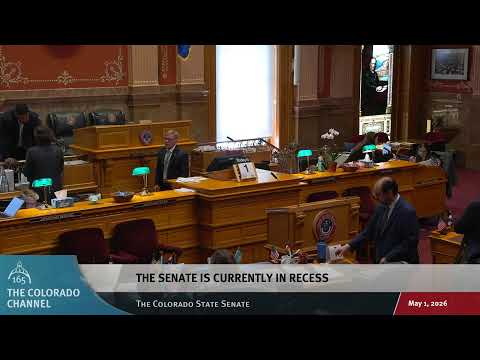
The Senate on May 1 adopted House Bill 11 13, an election-reform package described by sponsors as a mix of technical updates, expanded voting windows and protections to safeguard elections.
Sponsor Senator Wallace opened debate by framing Colorado as a national model for turnout and saying HB11 13 makes incremental and important improvements to security and access. "This bill builds upon that work through extended voting windows, earlier access to those drop boxes, and polling centers that will stay open longer," Wallace said.
Floor debate grew contentious on several provisions. Senator Zamora Wilson rose in opposition, arguing the bill "introduces administrative complexity and discretionary standards that may undermine uniform election practices," and raised concerns about centralization and alleged past errors in the Secretary of State's office. "To believe that we are the gold standard, I would say that's a belief," Zamora Wilson said, citing perceived vulnerabilities and alleging prior mistakes and problematic audit access.
Senator Weissman rebutted, invoking federal protections and the National Voter Registration Act (NVRA), saying there are interlocking protections and mechanisms to remove ineligible registrations and arguing some criticisms were unfounded and risked stirring rhetoric that endangers election workers. "We have mechanisms... we run the voter master at the SOS against death records collected by CDPHE," Weissman said.
The floor also considered and voted on multiple amendments. Amendment L33, which would have required higher-education election-related emails to be strictly informational and nonpartisan, was offered and then lost after a division. Amendment L34, proposed to restore county clerks' explicit authority to cancel inactive registrations alongside the Secretary of State, was debated and lost in a recorded voice vote; proponents argued local clerks are best positioned to maintain rolls while sponsors said the SOS process automates and incorporates clerks' work. Amendment L24, which restored a process for individual electors to challenge registrations, was adopted.
After further debate and the adoption of several amendments, the Senate adopted HB11 13. The clerk announced the bill was adopted on final passage; the transcript does not record a numerical final tally in the excerpt provided.
Supporters said the changes improve accessibility and security; critics pressed concerns about centralization and auditing authority. Implementation questions—how responsibilities are divided between county clerks and the Secretary of State and how automated systems will operate in practice—were left for rulemaking and administrative guidance.