Get Full Government Meeting Transcripts, Videos, & Alerts Forever!
Get email alerts on the Land Use Zoning topic
No spam. Unsubscribe anytime.
Lucas planning panel denies SUP for Creekwood Academy after neighbors cite traffic, safety and zoning concerns
Summary
The Lucas Planning and Zoning Commission on July 11 denied a request to allow Creekwood Academy, a proposed K–8 micro‑school at 2300 Songbird Trail, citing neighborhood safety, septic capacity and compatibility with residential zoning; the motion to deny passed 4–0.
The Lucas Planning and Zoning Commission voted 4–0 on July 11 to deny a special use permit that would have allowed Creekwood Academy, a proposed nonprofit K–8 micro‑school, to operate from a single‑family home at 2300 Songbird Trail.
Development services staff told the commission the home’s main structure totals about 2,654 square feet and that the applicant proposed an accessory building originally shown at 4,500 square feet and later reduced to 2,600. Staff recommended approval with conditions including no signage, no extracurricular activities after dark, no additional exterior lighting, a two‑year SUP trial period, a 40‑student cap and verification by a registered sanitarian that the existing on‑site sewage facility (OSSF) would support the use.
“Initially we were homeschooling our kids and a few friends,” applicant Michael Westfall said. “We want to hire some teachers and share those costs, not run a large school, and we have no ambitions to be a Lucas Christian Academy.”
Residents who live closest to the property urged denial. Deborah Jacobs of Ford Lane warned of a “slippery slope,” saying the commission earlier denied a related residential use and that formalizing a school could invite larger future uses. “When you allow one, and make it a use tied to the land, that means someone could sell and a mega‑school could come in,” Jacobs said.
Neighbors cited multiple specific concerns: limited screening on the Hendricks side that leaves sight lines in winter, increased dust and noise on the gravel driveway, stormwater and creek hazards, and the risk that fencing installed to secure a school would reduce property values. Paul Thomas, who shares a corner of the subject property, said he bought his home based on the existing residential zoning and that approval would change resale expectations.
Development services staff and the applicant addressed technical issues during commissioner questioning. Staff said the 40‑student cap was a planning estimate based on assumed usable indoor square footage and the two‑year limit was intended to let the city evaluate the fit. The commission asked whether a commercial kitchen would be required for on‑site meal service; the applicant said students would bring sack lunches and no meals would be prepared for the public. Staff noted that any future enlargement or construction of a detached structure would trigger building‑code upgrades (including paving to meet recently revised local standards) and IBC/ADA requirements.
On fire and emergency access, staff said the gravel drive has been used by heavy vehicles and Lucas emergency responders for training, but acknowledged the configuration would present a challenge for large apparatus and that any new barn or major structure would require a designed drive to the city’s standards.
Supporters included several families and neighbors who described the proposal as a micro‑school or homeschool co‑op for about 24 students initially and praised the applicants’ community ties. Becca Novotny, who said her child will attend three days a week, told commissioners the school would operate between about 8:30 a.m. and 3 p.m. with no after‑school programs or lights.
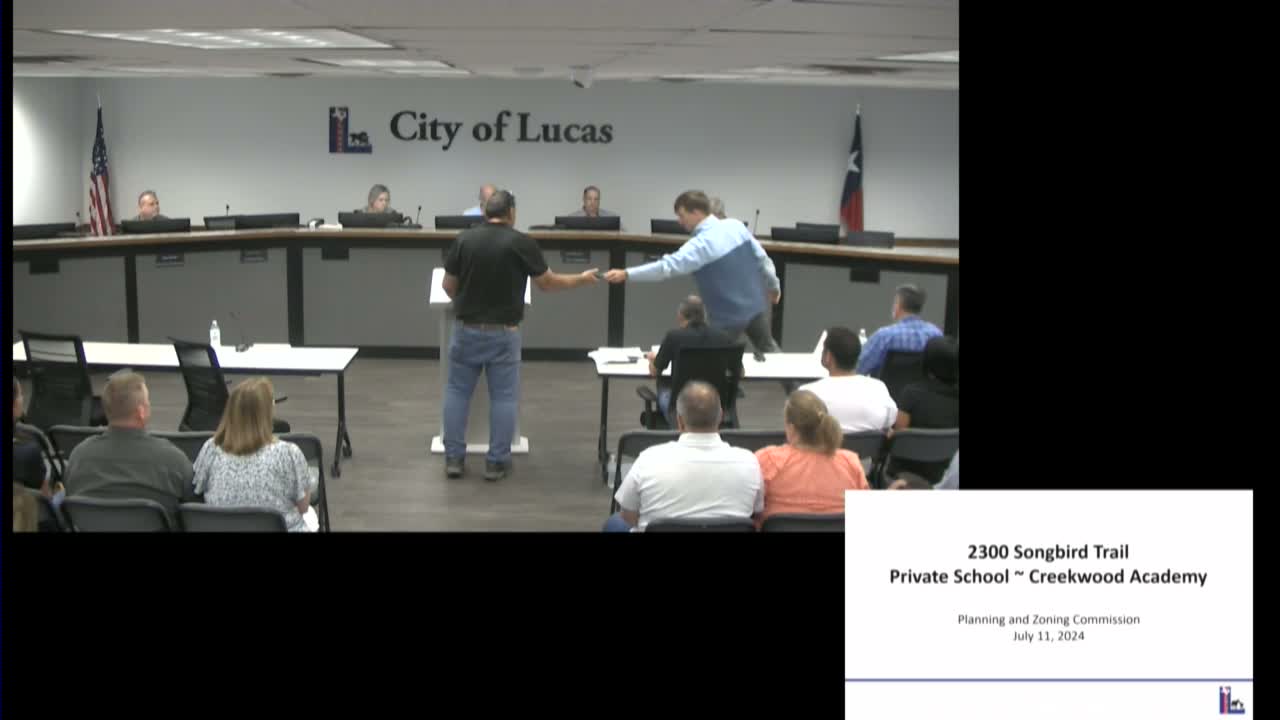
After public comment and applicant responses, Commissioner (speaker 2) moved to deny the SUP; the motion was seconded and carried on a 4–0 vote. The minutes record the motion to deny the request by Michael Westfall, property owner of 2300 Songbird Trail, for a specific use permit to allow a private school in an R‑1 residential zone.
The denial leaves the applicant the option to revise the proposal and return to the city. Staff had recommended a two‑year SUP trial and several operational limits; commissioners instead expressed that the potential impacts for immediate neighbors outweigh the benefits in this location.
Action at a glance: Motion to deny the SUP for Creekwood Academy; mover: Commissioner (speaker 2); second: Commissioner Oliver (speaker 4); outcome: denied 4–0.
What’s next: The applicant may revise the plan or seek a different site. The commission did not adopt staff’s recommended SUP conditions because it voted to deny the permit.