Get AI Briefings, Transcripts & Alerts on Local & National Government Meetings — Forever.
Erie County finance meeting reviews supplemental appropriations for public health, MHID, children and youth and a $105,000 CDBG pass‑through
Summary
At its April 30 finance meeting, Erie County officials reviewed multiple supplemental appropriations including $38,344 for initial Great Lakes public‑health funding, $105,692 in state public‑health funds for wastewater surveying, a $346,454 MHID revenue recognition, $345,000 for children and youth placements, and a $105,000 CDBG pass‑through for Union City curb cuts; no votes appear in the transcript segments provided.
Erie County’s finance meeting on April 30 reviewed several supplemental budget items and other finance matters, including public‑health grants, mental‑health funding, children and youth placement costs, a Community Development Block Grant pass‑through for curb cuts in Union City and a possible county parcel sale.
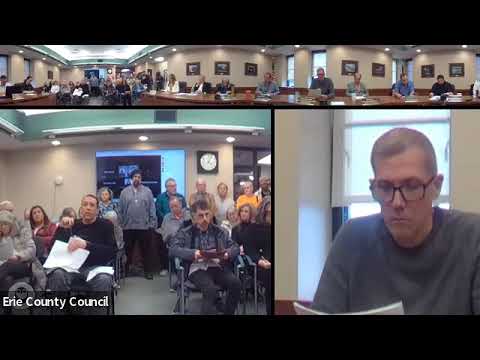
The meeting opened with roll call and a Chair who invited finance‑related public comment; none was offered. The Chair then read a series of ordinances on the agenda. The transcript contains no recorded motions or roll‑call votes for these items in the provided segments.
Ordinance 38‑20‑26 would add a 2026 supplemental appropriation of $38,344 to the public‑health fund to create new line items for initial funding for an entity referenced as Great Lakes. The transcript records the ordinance being read but does not record further discussion or any vote in these segments.
Ordinance 39‑20‑26 proposes a $105,692 supplemental appropriation and new line items tied to Pennsylvania Department of Health funding for a wastewater surveyor. The clerk noted this item was a first reading on April 21.
The board also reviewed Ordinance 40‑20‑26, which seeks approval of a waiver of bid requirements under the county purchasing code to contract with Highway Safety Network Incorporated. The transcript records the ordinance’s introduction but provides no details of the contract value, procurement rationale beyond the waiver language, or a recorded vote in the provided segments.
On child‑welfare spending, Chair read Ordinance 20‑26 proposing revised children and youth services expenditures of $345,000 to create expense line items for court‑ordered placements. Patrick, who speaks later in the meeting and is identified by first name only in the transcript (role not specified), described the item as a maintenance adjustment to create four new line items for placement facilities that were not budgeted in 2026.
An MHID (Mental Health and Intellectual Disabilities) supplemental appropriation of approximately $346,454 was presented to recognize additional MHID revenue not allocated when the 2026 budget was prepared. Patrick explained that the ordinance would recognize that revenue and realign related expense lines.
On planning and community development, the Chair introduced a planning fund supplemental appropriation of $105,000 to create new bureau and line items for a CDBG program grant to Union City for curb cuts. Tony, who identified himself as the CDBG program administrator, explained the work was completed this spring and that the $105,000 is “pass‑through funding” to ensure contractors are paid. As Tony put it, “It doesn’t cost county anything.”
The Chair also noted a possible sale of a parcel from the repository for unsold property (index number given as 001.70). The transcript segments provide the index reference but do not include listing details, buyer information, price or a motion.
Patrick reported that if the ordinances presented were approved, the county would be in compliance with required fund and unrestricted fund balance levels, and cited a figure of $22,819,620 for general fund expenditures/unrestricted fund balance.
Several procedural clarifications followed: staff and the clerk discussed whether items would be moved to a second, and the Chair reminded the audience that the board of elections meeting later in the day uses a separate Zoom link.
Next steps: the transcript segments end with these introductions and clarifications; no final votes or formal outcomes on the ordinances appear in the provided segments. Additional meeting minutes or later segments would be needed to confirm motions, seconds and any vote tallies.