Get AI Briefings, Transcripts & Alerts on Local & National Government Meetings — Forever.
Brookline forum frames $23.25M override as choice between preserving services and protecting affordability
Summary
At a League of Women Voters forum, proponents and opponents of a $23,250,000 operating override presented competing cases: supporters warned of large cuts to schools and public safety if the override fails; opponents called the ask unaffordable, criticized transparency and urged structural reforms before a permanent tax increase.
At a League of Women Voters of Brookline forum, proponents and opponents of the town’s proposed $23,250,000 operating override laid out competing cases ahead of the May 5 ballot. Supporters said the override is needed to avoid deep cuts to schools and town services; opponents said the increase is unaffordable and urged the town to pursue alternatives.
The override ask was described by Chaz Carey in an early overview as “approximately $23,250,000, of which 5,310,000 would be going to municipal departments, and the remainder will be going to the school department.” A yes vote would permit a permanent increase to the town’s levy, phased in over multiple years; a no vote would leave the town to balance its budget within Proposition 2½ limits and any new-growth allowances.
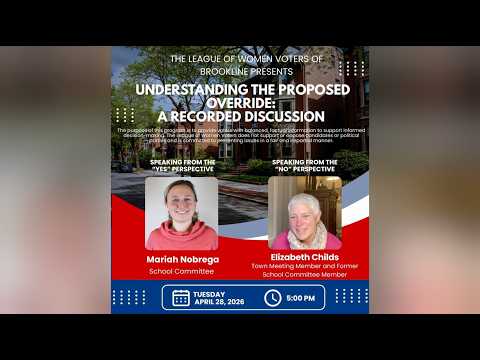
Mariah Nobrega, a member of the Brookline School Committee and a lead proponent at the forum, said passing the override would prevent immediate and sweeping cuts to services. She warned of specific program losses and staff reductions if the override fails: “World language and music in grades 6 through 8 will be gone for at least next year,” Nobrega said, and she described scenarios that could eliminate roughly 130 classroom teaching positions over multiple years and require up to 20 firefighter layoffs in later years. Nobrega framed the override’s incremental cost as necessary to preserve the town’s existing level of education, public safety and senior services and described the request as a “Corolla, not a Cadillac,” echoing the town administrator’s language to indicate maintenance of current services rather than new programs.
Elizabeth Childs of Keep Brookline Affordable argued the opposite: the $23.25 million ask is too large and risks worsening housing affordability. Childs said the study committee received the formal school budget only two days before its final report and criticized the lack of time to evaluate how the money would be spent. “This override at 23,250,000 … is too expensive,” she said, urging voters to require clearer plans and efficiency measures—such as renegotiated health premium contributions and changes to salary structures—before approving a permanent levy increase.
Both sides disputed the size of the tax impact. Nobrega and supporters described the override as adding roughly 7% more to property taxes over three years compared with what taxes would otherwise be, while Childs and other opponents cited higher aggregate figures (she characterized an 18% increase over three years when combined with recent changes). Forum speakers also noted that, even without the override, Brookline faces baseline tax increases under Proposition 2½ plus any excluded debt.
Speakers outlined how the override funds would be allocated: proponents and town staff presented $5.3 million for municipal services in year one and the balance for schools across a three-year phase-in; opponents stressed that more than 70% of the total supports the schools and pressed for clearer, itemized plans. Panelists emphasized process differences: Nobrega described the multi-stage budget forecasting process used by school and town staff; Childs faulted study-committee access to detailed school-budget materials and called for greater transparency and stronger cost-control proposals.
The forum featured repeated exchange on consequences of a no vote. Nobrega warned of program eliminations, larger class sizes and reductions in emergency response capacity; Childs countered that the town could use reserves as a bridge, press for contract negotiations and pursue structural reforms without a permanent levy change. Neither side presented a formal motion or vote at the forum; the discussion was expressly advisory to inform voters before the May 5 ballot.
The League of Women Voters moderated the discussion and reminded viewers it takes no position on the question. The forum recording will be shared so residents can review the competing arguments before voting.