Get Full Government Meeting Transcripts, Videos, & Alerts Forever!
Get email alerts on the Esg Investments Pensions topic
No spam. Unsubscribe anytime.
County retirement staff say ESG approach cut fossil-fuel exposure by over 40% while keeping plan well funded
Summary
Montgomery County retirement-plan staff told a joint council committee that their ESG investment approach has reduced fossil-fuel exposure by more than 40% since 2017, while the pension fund is about 98.6% funded; officials cautioned full divestment carries costs and asked for follow-up climate-risk manager reports.
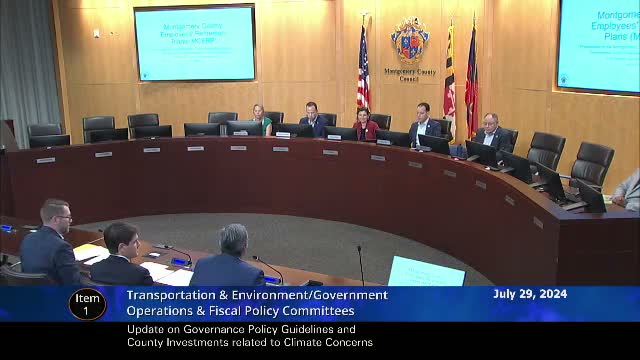
Eli Martinez, executive director of the Montgomery County Employees Retirement Plans, told a joint session of the Government Operations and Fiscal Policy Committee and the Transportation and Environment Committee that the plans’ ESG approach has substantially reduced fossil-fuel exposure while preserving funding.
“we can solidly say that McCurp is a leader in ESG,” Martinez said, and he summarized the plan’s recent performance and metrics: “our performance has been very strong over the last 10 years, over 8% annualized return, net of fees,” and the ERS is “98.6% funded.” He also said that “since 2017 … our fossil fuel exposure has come down, by over 40%.”
Why it matters: committee members framed the discussion as balancing the trustees’ fiduciary duties to retirees with broader environmental goals. Members repeatedly pressed staff on how climate risk is incorporated into investment decisions, and asked for examples of manager climate-risk reports and the county’s compliance checks.
Martinez and staff described how the boards’ duties — the exclusive-benefit rule, duty of loyalty, duty of care and prudence, and applicable IRS and Department of Labor rules — constrain trustees’ choices and require a focus on long-term, risk‑adjusted returns. Martinez said the plans have pursued ESG through manager diligence, portfolio reporting and contract terms that require disclosure and periodic impact reporting from managers.
On the costs and trade-offs, Martinez cited consultant estimates and peers’ work. He told the committee that a consultant’s analysis suggested divestment could create opportunity costs “that could mean up to $44,000,000 per year in cost by virtue of opportunity losses.” He also said that smaller performance differences can still have fiscal impact: he cited a range of roughly “point 0.03 to point 1%” as the performance range that could translate into additional contribution pressure, and used an illustrative conversion of about $8,000,000 per 0.1% as a way to conceptualize scale.
Committee members pressed staff on climate risk beyond energy-sector holdings. Council President Friedson asked about real-estate exposure in flood plains and other climate-sensitive locations; Martinez and Kevin Calivi, the plans’ CIO, said the plans generally favor higher‑quality, LEED‑certified real‑estate allocations and diversify across geographies to limit exposure, but they acknowledged that a single standardized portfolio‑wide climate‑risk metric for all asset types remains a developing capability.
Councilmember Katz asked what the plans’ asset mix looks like and how returns would differ without the ESG posture. Staff estimated real estate is in the high single digits (about 5–10% of the portfolio) and said that Martinez’s back-of‑envelope comparison indicated approximately $4.9 million less per year for the ERS if fossil‑fuel exposures were removed in a given counterfactual; Martinez framed that as roughly a few‑hundredths to one‑tenth of a percentage point in return difference depending on the assumptions.
On manager oversight, Martinez said managers receive ESG scores at selection and the plans have a compliance process that monitors whether managers invest according to their stated mandates. Councilmember Glass asked directly whether managers are evaluated for social‑justice and racial‑equity factors; Martinez said managers are given an ESG score at the point of inception and compliance work seeks to ensure they follow those practices.
No formal action was taken at the meeting. Committee members asked staff to provide sample manager climate‑risk reports and additional follow-up on how state policy (including work by Comptroller Brooke Lierman, which members noted) could inform the county’s approach. The session concluded with the vice president thanking presenters and noting the plans’ annual reports are publicly available.
The committees will continue the conversation and requested supplemental reports from staff and the plans on portfolio climate‑risk analysis and manager reporting.