Get Full Government Meeting Transcripts, Videos, & Alerts Forever!
Get email alerts on the Adu Production Local topic
No spam. Unsubscribe anytime.
Montgomery County committee hears ADU update; staff cite 265 permits since 2019 and say financing remains the key barrier
Summary
At a July 29 Planning, Housing and Parks Committee meeting, county staff reported 265 ADU building permits issued since December 2019, 93 licensed ADUs, 162 renewals pending and 86 conditional cases; members directed staff to provide cost breakdowns, maps and explore financing, amnesty and preapproved plans.
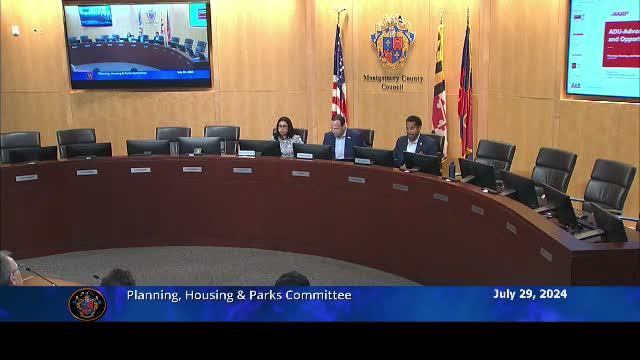
Montgomery County Council President Friedson on July 29 convened the Planning, Housing and Parks Committee to receive an update on accessory dwelling units (ADUs), hearing a national overview from AARP, implementation data from county housing and permitting staff, and a summary of Office of Legislative Oversight research.
"Now, probably $150,000 to $250,000 to build that same structure" is the current estimated construction cost range for an ADU, Friedson said, echoing a concern that repeatedly surfaced in the meeting about financing as the principal barrier to wider ADU uptake.
Samar Jha of AARP framed ADUs as independent, accessory living units that can expand housing choices, support aging-in-place and provide rental income. Jha said ADUs are experiencing renewed interest nationally but that data collection is uneven; she urged pairing liberalized local rules with financing supports and cautioned against "poison-pill" restrictions such as strict owner-occupancy covenants, mandatory parking minimums and conditional-use processes that slow or block production.
County permitting and licensing staff presented local implementation figures and processes. Ihsan Mottazidi, deputy director of the Department of Permitting Services (DPS), described the ePlans electronic intake and review workflow and said the average calendar time to issue a building permit for an ADU is about 54 business days (17 business days of DPS review plus an average of 37 business days while the applicant responds). Mottazidi also said DPS calculates building permit charges at $0.76 per square foot.
From the Department of Housing and Community Affairs (DHCA), staff reported licensing and compliance data. As of mid-July, DHCA said it had 93 ADUs fully licensed, 162 units with renewals pending (the annual renewal fee is due July 31) and 86 conditional cases that still need inspections or repairs before full licensing. DHCA staff characterized many pending cases as properties identified through complaints that staff are attempting to engage; conditional cases have had a preliminary inspection and require owner follow-up.
Committee members pressed staff to clarify fees and the counts. Staff said the initial rental-license inspection fee is $612 and the ongoing annual renewal fee is $125; council members asked staff to present future charts that separate "ongoing licensed" units (those already in the regulatory regime) from "new/conditional" permits so trends are clearer.
On production volume, DPS reported 265 ADU building permits issued since December 2019, the date county law changed to make many ADU configurations (detached, attached, basement) allowed as-of-right. DPS said permit activity clusters in older neighborhoods; Silver Spring ZIP codes showed the largest count (84), followed by Bethesda (34) and Potomac (24). Councilmembers asked staff for a ZIP-code map and a transit-proximity breakdown.
The Office of Legislative Oversight (OLO) — represented by Chitra Kalyander — said the 2019 local amendments aligned Montgomery County with many national best practices but noted two areas for additional work: the practical enforcement of owner-occupancy conditions and the absence of dedicated lending products or state-level financing supports. OLO also flagged restrictive covenants held by homeowners associations as a constraint beyond the county’s direct authority.
Members discussed policy options highlighted in other jurisdictions: short amnesty periods and fee waivers (used in Santa Cruz and some California counties) to bring previously unpermitted units into compliance, grant or low-interest loan supports (California programs that offer up to roughly $40,000–$45,000 for homeowners to build ADUs were cited as examples), system development charge waivers tied to rental commitments (Portland example), and offering preapproved template plans to reduce design and soft costs.
The committee identified near-term follow-ups: staff will provide a combined fee and cost breakdown (DHCA and DPS), a ZIP-code map of ADU permits with transit proximity, options for amnesty or fee-waiver programs to legalize unpermitted units, and an analysis of preapproved template plans to reduce soft costs. Members also asked staff to draft a letter to state partners exploring financing supports modeled on successful state programs.
The meeting closed with staff pledging to return with the requested data and policy options; the committee adjourned without a formal vote on new legislation.