Get Full Government Meeting Transcripts, Videos, & Alerts Forever!
Get email alerts on the Waterfront Specific Plan topic
No spam. Unsubscribe anytime.
Berkeley council directs staff to finish parking study, add Cesar Chavez plan and pursue EIR for high build-out
Summary
After presentations and extensive public comment, the Berkeley City Council voted to direct staff to complete the Pier Ferry parking study, prepare a nature-and-recreation conceptual plan for Cesar Chavez Park, and then pursue an EIR studying the high-development scenario; the motion passed by roll call.
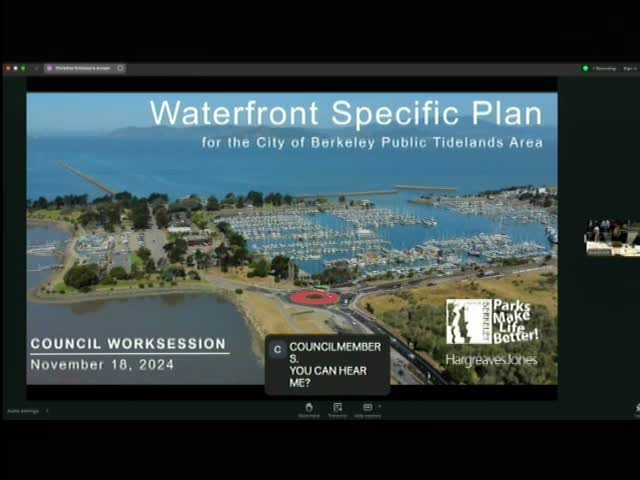
Vice Mayor opened a Nov. 18 special meeting of the Berkeley City Council on the Waterfront Specific Plan and heard a staff presentation laying out the plan’s purpose, fiscal context and three development scenarios. Parks, Recreation and Waterfront Director Scott Farris told the council the waterfront currently generates about $2.2 million a year in Marina Fund revenue, that the Marina Fund runs an approximately $850,000 annual operating deficit and that the city has identified roughly $94 million in unfunded waterfront infrastructure needs (exclusive of the Berkeley Pier).
The staff presentation and commission briefing framed the core choice: proceed now to environmental review under a selected study envelope, pause to finish additional studies, or stop the project. Scott Farris said Measure Y, the new parks tax, is expected to shift about $1.5 million in operating costs off the Marina Fund but would not cover the full capital shortfall. He told council: “Today, that operational deficit is at $850,000 a year.”
The Parks, Recreation and Waterfront Commission urged caution. Incoming commission chair Alan Apchas told the council the commission adopted seven unanimous recommendations and urged a short pause so the city could complete Task 3 of the parking study and prepare a Chavez Park conceptual plan. “Wait for task three’s analysis and recommendations,” Apchas said, arguing that completed parking analysis would give the council “a well-informed decision regarding the WSP, including how much development is appropriate.”
Public commenters echoed the commission’s request. Speakers representing sailing groups, conservation organizations and residents repeatedly pressed the council to finish the parking study and to keep Cesar Chavez Park focused on nature and recreation; concerns included peak parking counts, preservation of the boatyard and equitable access. Several speakers warned renderings showing commercial uses in Chavez Park had generated public backlash and urged the council to avoid returning commercial plans to that park.
After discussion and questions about timing, budget and legal authority, Councilmember Taplin moved — and the motion was seconded — to direct staff to complete the parking study, prepare a nature-and-recreation conceptual plan for Cesar Chavez Park, then pursue an environmental impact report (EIR) using the high-development scenario as the study envelope, and return to council for final approval and EIR certification. Legal staff had earlier advised the council that it could direct staff to complete specified studies and then initiate environmental review under those parameters.
The council approved the motion by roll call (affirmative votes recorded for Councilmembers Castorwani, Taplin, Bartlett, Trego, Hahn, Weingraff, Una Parra and Humbert). The motion carries the following instructions to staff: finalize Task 3 of the parking study (Pier Ferry–linked analysis), prepare the Chavez Park conceptual plan focused on nature and recreation, and allow CEQA analysis to proceed using the high study envelope so the council can review the EIR and choose among studied options at a later date.
What happens next: staff said the parking study should be finalized within roughly two to three months and that completing the Chavez Park conceptual plan would require additional funding (staff estimated the Chavez conceptual plan could cost in the low hundreds of thousands of dollars). If the council authorizes proceeding to CEQA, staff expects to return in 2026 with the EIR results and specific zoning recommendations. The meeting adjourned after the vote.
Sources: presentation and fiscal figures presented by Scott Farris and staff; commission recommendations delivered by Alan Apchas; legal clarification from Lauren Packard; multiple public commenters urging a pause.