Get Full Government Meeting Transcripts, Videos, & Alerts Forever!
Get email alerts on the Economic Development topic
No spam. Unsubscribe anytime.
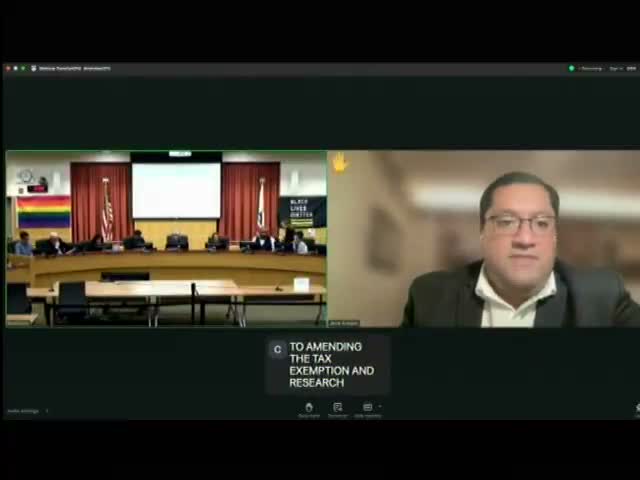
Berkeley council expands R&D grant tax exemption to keep startups in the city
Summary
On first reading the council broadened Berkeley’s R&D grant exemption—removing a $1 million lifetime cap and a $100,000 other‑receipts limit and adding philanthropic grants—after debate about fiscal impacts and public outreach.
The Berkeley City Council on Oct. 29 voted on first reading to amend the municipal code to expand an existing exemption that excludes government research and development grants from business gross receipts taxation.
Mayor (speaker 7) and staff from the Office of Economic Development said the change removes a lifetime cap of $1,000,000, eliminates a restriction that a firm must have less than $100,000 in other gross receipts to qualify, and extends the exemption to philanthropic grants that fund public‑interest R&D.
"This proposal and staff can clarify this would have an economic impact of $9,000 a year on the city's general fund," the mayor said during the presentation. Economic development staff explained that over the past five years they approved waivers for 21 companies and that the cumulative foregone amount averaged roughly $9,000 per year, which staff argued is small compared with the potential economic benefits of retaining startups.
Eleanor Hollander (speaker 42), manager of the Office of Economic Development, and Liz Redmond Cleveland (speaker 38) laid out the intent: keep early‑stage, often federally funded or philanthropy‑funded research firms in Berkeley so they grow here, hire locally and spend in the city. Staff noted that many peer university towns do not impose gross‑receipts business taxes on early‑stage R&D activity and argued Berkeley’s reform helps city competitiveness.
The proposal drew robust public comment both for and against. Supporters from the startup and life‑science community — including founders and representatives of Baker Labs, Activate Berkeley and the Berkeley Chamber of Commerce — said grant-funded startups often cannot use grant dollars to pay local taxes and that the exemption reduces a barrier to survival and growth.
Opponents, including several residents and small‑business owners, said the staff presentation lacked sufficient fiscal detail and urged limits, a sunset clause or additional public outreach. "There should be a sunset and more analysis," said a resident in public comment who asked staff to provide clearer numbers on likely foregone revenue and scenarios if large grants or larger employers benefit.
Council members who supported the ordinance cited the small estimated fiscal impact and the potential for long‑term economic activity—jobs, rents and local spending—if startups grow in Berkeley. The council adopted the proposal on first reading with a unanimous roll‑call vote.
The ordinance now proceeds to the next legislative step; staff and council members said they would monitor outcomes and continue outreach to the community.