Get AI Briefings, Transcripts & Alerts on Local & National Government Meetings — Forever.
Franklin board hears City Hall construction update; aldermen press for clearer cost breakdowns
Summary
Officials were updated on the City Hall block redevelopment, including construction progress and a contractor GMP in the mid‑$90 million range; aldermen requested variance reports, contingency detail and refined furniture cost estimates.
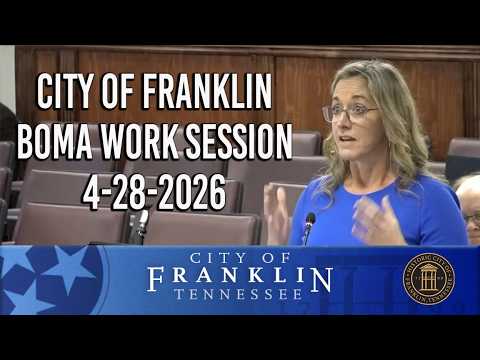
City staff and the city's owner's representative briefed the Board of Mayor and Aldermen on April 28 about progress and costs for the City Hall block redevelopment, which includes a roughly 97,460‑square‑foot new City Hall, a one‑acre public park and an approximately 200‑space subsurface garage.
Chris Kepper, the owner’s representative, walked the board through recent construction progress photos and noted value‑engineering efforts. Kepper said the contractor’s guaranteed maximum price (GMP) was in the mid‑$90 million range, with contingency and allowance buckets built into the contract and roughly $3.3 million in contingency allowances being tracked for potential use. He described accepted value engineering items totaling more than $9.3 million and additional items in review.
Board members asked for more granular variance reporting showing what categories have increased or decreased since earlier estimates and requested a clear explanation of how shared savings and contingency distributions would be calculated if construction costs come in below the GMP. Kepper said the GMP covers construction costs only and that other project costs (furniture, technology and owner‑furnished items) are tracked separately and are not part of the contractor’s GMP.
On the furniture contract for the new building, staff proposed using a Nashville distributor to procure and install commercial‑grade furnishings for more than 200 workstations and a range of public and meeting spaces. Staff said the current budget number is conservative and that the team will pursue cooperative purchasing options (Omnia) and additional value engineering to reduce cost while retaining commercial‑grade durability.
Aldermen cautioned that repeatedly trimming furniture or finish quality can lead to higher lifecycle replacement costs; one board member asked for a transparent line‑item reconciliation of earlier soft bids versus the current, more comprehensive estimate.
What happens next: staff committed to supplying detailed variance analyses for prior cost estimates and to return with a refined furniture cost and procurement plan. The board also directed staff to clarify shared‑savings language and contingency accounting in the GMP documentation before final action.