Get Full Government Meeting Transcripts, Videos, & Alerts Forever!
Get email alerts on the Housing topic
No spam. Unsubscribe anytime.
Consultants: Franklin faces a shortfall of thousands of homes as households grow and prices rise
Summary
A housing study presented to Franklin’s Board of Mayor and Aldermen warns of major shortages at multiple price points, projecting about 3,500 new households in Franklin by 2030 and identifying gaps of roughly 3,800 rental and 6,200 for‑sale units without targeted action.
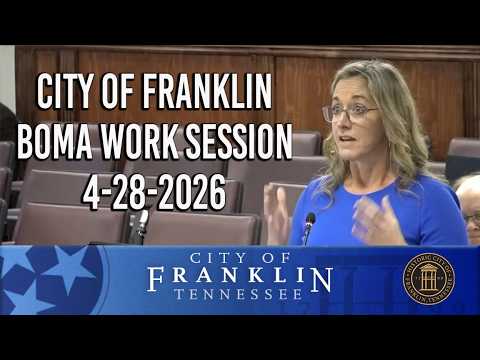
Patrick Bowen of Bowen National Research told Franklin’s elected officials on April 28 that the city is poised to add roughly 3,500 households between 2025 and 2030, a pace that will strain existing housing stock and affordability.
“Franklin is projected to add about 3,500 households from 2025 to 2030,” Bowen said during a work‑session presentation organized by the Williamson County Association of Realtors. The consultant compared Franklin (the primary study area) with the balance of Williamson County and said the city’s growth is amplified by even faster household growth in surrounding communities.
The study enumerated several pressures: a large share of future renter and owner demand will be among higher‑income households, while many existing residents are cost‑burdened. Bowen said roughly 10,000 Franklin households pay more than 30% of income for housing and about 4,500 pay more than half — a level the report calls “severe cost burden.” He also reported that a market survey of multifamily properties found about a 95% occupancy rate for market‑rate apartments and that tax‑credit and subsidized units are effectively full with long waiting lists.
Bowen highlighted stark for‑sale scarcity: the consultant reported 283 homes available as of August 2025 and said only three were listed under $300,000 in the inventory used for the study, leaving typical working households with few ownership options. Median sales prices in the dataset rose into the high hundreds of thousands and were shown near $815,000 in 2024 with partial 2025 data close to $800,000.
The study also quantified a regional workforce mismatch. Bowen said about 76,000 people commute into Franklin each day while roughly 11,000 both live and work in the city, creating leakage of earned income to other communities and complicating employer recruitment and retention.
To address the shortfall the consultants did not prescribe a single solution but presented a menu of approaches: preserve and repurpose existing underused buildings, identify city‑owned land for affordable development, consider fee discounts or other public incentives for projects that include lower‑cost units, and explore density bonuses or expedited review in exchange for affordable units. Bowen noted that many of the financial shortfalls could be reduced through housing assistance programs such as vouchers or first‑time homebuyer aid rather than building all units outright.
Beau Patton of the Williamson County Association of Realtors, who introduced the study, urged continued community outreach and said the association and its partners would provide contacts and examples from other jurisdictions to help the city design incentives. Patrick Bowen offered to supply additional data and meet with staff on targeted follow‑ups.
What happens next: the study will be part of staff and commission review; aldermen questioned several data points and asked staff to reconcile commute figures with county transportation board numbers. The study’s full report, including developer and employer surveys and a list of potential financing and incentive tools, is available to city staff and will inform forthcoming policy discussions.