Get AI Briefings, Transcripts & Alerts on Local & National Government Meetings — Forever.
Court-reporting groups press commission to accept NCRA RPR; petition referred to advisory board
Summary
Multiple court-reporting instructors and association leaders urged the Judicial Branch Certification Commission to recognize the NCRA Registered Professional Reporter (RPR) credential as meeting the Texas CSR skills requirement; the commission voted to refer the petition and related rule changes to its advisory board for further review because of statutory constraints on exam administration.
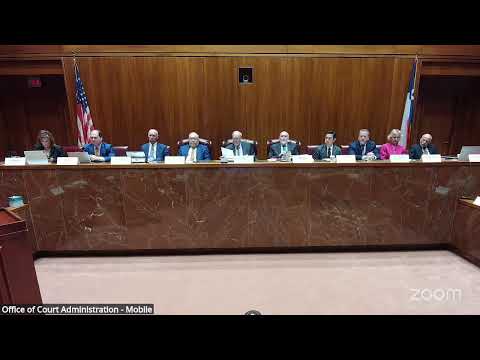
A coalition of court-reporting instructors and national association leaders told the Judicial Branch Certification Commission the commission should recognize the National Court Reporters Association’s Registered Professional Reporter (RPR) credential as satisfying the skills portion of the Texas certified shorthand reporter (CSR) exam. After extensive public comment, the commission voted to delegate consideration of the petition to its advisory board.
Public commenters who identified themselves as instructors, program directors and association officers described the RPR as a nationally recognized, competency-based credential administered on the same platform used by the Texas CSR. Erminia Ubeado, who identified herself as a court reporter and a certified court reporting instructor, said she and other educators were "respectfully asking the Judicial Branch Certification Commission to adopt the proposed rule changes allowing recognizing the National Court Reporters Association registered professional reporter certification as satisfying the skills exam requirement." She emphasized that educators want the RPR "in addition to"—not to replace—the Texas CSR.
Melinda Gadega, a past president of a state court-reporting association, and Christie Smith, a program director and instructor, told commissioners that allowing reciprocity would increase license portability and reduce delays that keep graduates from entering the workforce. Cindy Isaacson, president of the National Court Reporters Association, described the RPR as "a nationally recognized credential" that uses objective competency-based exams and said recognizing it would preserve standards while expanding access.
Several commenters argued that current rules create a structural barrier for in-state graduates: provisional-license rules require three years' experience within a five-year period before licensing via provisional pathways, but graduates cannot gain that experience without a license. "This is not a training issue. It is not a competency issue. It is a structural issue," one commenter said, urging the commission to remove the barrier.
Staff and commissioners noted a statutory constraint: the Texas statute prescribes certain elements of the CSR skills exam, including the requirement that the skills portions be completed in a single sitting, whereas the RPR permits passing sections in separate sittings and retains passing legs for a period of time. Staff advised the commission that this statutory specificity complicates direct substitution of the RPR for the CSR skills component and recommended sending the petition to the advisory board for further consideration.
The commission voted by voice to delegate the proposed rulemaking on the CSR exam and related recognition of the RPR to the advisory board for detailed study and recommendation. Staff said they will notify the advisory board and report back with any recommended language, consistent with statutory constraints and stakeholder input.
What happens next: the advisory board will review the petition and related rule language, consider statutory limitations identified by staff, solicit further input as necessary, and return recommendations to the commission. Any final rule changes would be subject to public comment and, if required by statute, review or promulgation by the Texas Supreme Court.