Get Full Government Meeting Transcripts, Videos, & Alerts Forever!
Get email alerts on the Affordable Housing topic
No spam. Unsubscribe anytime.
Joint committee approves Clarksburg Library affordable-housing feasibility study; seeks fuller cost and mixed-use analysis
Summary
On Oct. 21 the Montgomery County Council joint committee approved a Department of General Services feasibility study examining co-locating affordable housing with the planned Clarksburg Library under Bill 33-22, while members pressed DGS for clearer cost estimates, "blue-sky" stacked options and details on developer partnerships.
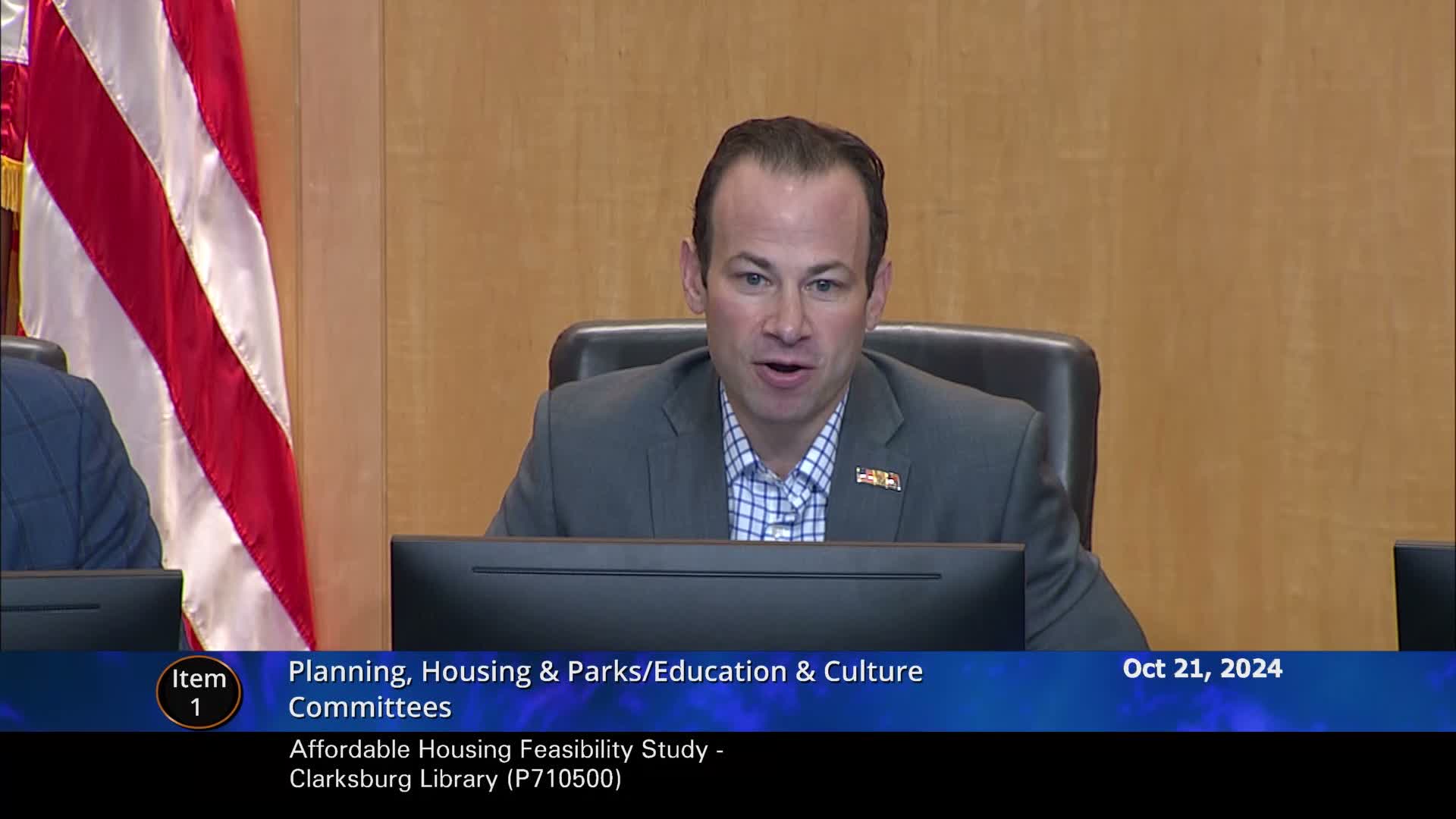
Montgomery County's joint committee on Planning, Housing & Parks and Education & Culture voted Oct. 21 to approve an affordable-housing feasibility study for the Clarksburg Library, but members pressed the Department of General Services for more detailed cost estimates for housing and for explicit scenarios that show stacked mixed-use options.
The study, transmitted under Bill 33-22 (enacted January 2023) and received by the council on Oct. 11, evaluates whether affordable housing can be co-located with the new library at the recently purchased site at the corner of Maryland 355 and Stringtown Road. Council staff recommended the committee approve the analysis as transmitted.
"We really prioritize and continue to prioritize co locating housing that we desperately want and desperately need on public land," said Chair Friedson, who opened the session. Friedson and other members framed the review as part of the council's effort to use scarce county land for affordable housing while protecting library program space.
Logan Ambinder, council staff, summarized the bill''s requirement that the council has 30 days after transmittal to approve or disapprove an affordable-housing feasibility study. Ambinder said council staff recommended approval of the Clarksburg study as submitted.
Greg Austin of the Department of General Services said the packet includes the capital cost estimate for the library itself but does not yet include projected construction costs for the housing components. "We don't have any cost information on projections of the actual housing itself," Austin said, adding that DGS has not begun the housing cost analysis because the library's site engineering and footprint must be established first.
Members repeatedly asked DGS to present a full range of options and associated orders-of-magnitude costs so policymakers can compare a stand-alone infill housing project, side-by-side co-location on the same parcel, and true mixed-use stacking (housing above a public use). Austin cautioned that stacking housing over public facilities can reduce unit yield because of additional elevator lobbies, stairwells and program impacts, and that feasibility is decided case-by-case.
"At a certain point, consideration begins to feel like an afterthought," Friedson said, urging that co-location be treated as a forethought in future projects. Several members said they wanted "blue-sky" scenarios that show what higher-density or stacked options would cost and how they would affect the library program and timeline.
Austin told the committee DGS anticipates bringing an affordable-housing partner on when appropriate, which would trigger property-disposition steps and require coordination with the Department of Housing and Community Affairs and council review. He pointed to recent examples where co-location was pursued but resulted in separate buildings, and named the Wheaton Arts and Cultural Center as a successful mixed-use partnership with Montgomery Housing Partnership.
Councilmember Balcom, the district representative advocating for the Clarksburg project, said the study reflected the discussions earlier in the budget process and emphasized the site's transit connections and potential for additional units. Other council members acknowledged community frustration over delays on projects such as the Chevy Chase Library and said they wanted feasibility work that does not unnecessarily stall construction.
Chair Friedson moved to approve the transmitted Affordable Housing Feasibility Study; the committee recorded the vote as unanimous. The chair said the council and executive branch would continue to work together on refining study detail, cost estimates and next steps for possible housing development on county land.
What happens next: the approved feasibility study remains the basis for future project planning. Committee members asked DGS to return with additional scenarios, cost magnitudes for housing options and clarification of when mixed-use stacking would be feasible without undermining library programmatic needs.