Get Full Government Meeting Transcripts, Videos, & Alerts Forever!
Get email alerts on the Housing topic
No spam. Unsubscribe anytime.
Alachua County commissioners direct staff to craft guidelines for $54 million housing surtax, prioritize workforce rentals
Summary
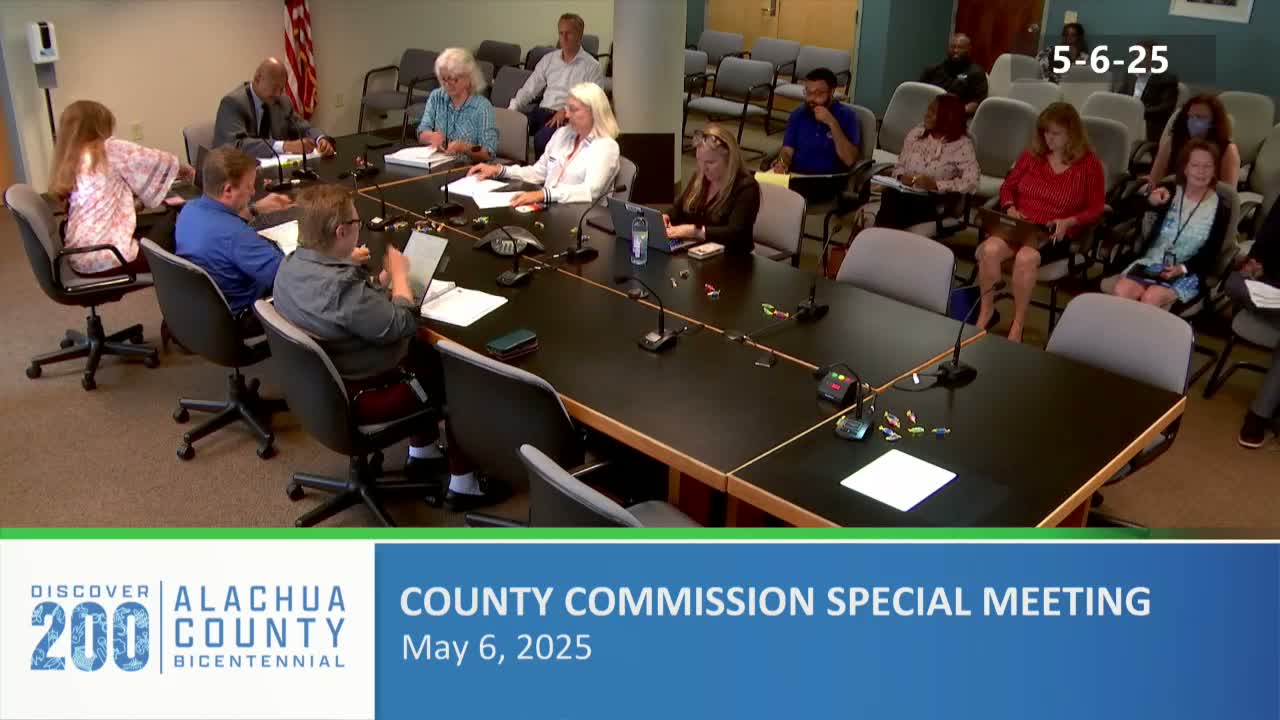
At a May 6 special meeting, Alachua County commissioners told staff to return with clear criteria for the Living Spaces and Thriving Places program that prioritize new workforce rental units and set caps and scoring metrics to leverage roughly $54 million in surtax funds.
Alachua County commissioners voted May 6 to direct staff to draft formal guidelines for the Living Spaces and Thriving Places program — the county’s housing allocation from the Wild Spaces & Public Places surtax — and to return with evaluation criteria to prioritize new workforce rental units and better leverage private capital.
Ralston Riudica, a housing program manager with Community Support Services, told the board the surtax earmarks roughly $54,000,000 for housing over 10 years and that staff has received three applications so far: Banyan Development (near the Royal Park Theater), a partnership between New Star Development and the Gainesville Housing Authority for Oak Park, and Oakview Apartments (J & E Properties). “We approximately have about $54,000,000 for 10 years,” Riudica said, summarizing the fund’s scale and intended gap‑financing role.
The motion asking staff to return with concrete targets and scoring criteria was made after a sustained policy debate. Commissioners pressed staff for more detail on each proposal’s address, total project cost and the share of county funding requested. Staff supplied preliminary figures: Banyan’s project was described as roughly $43.7 million for 104 units (or $38.4 million if reduced to 88 units) with a county request near $6.55 million; staff said Oak Park’s total project cost is about $36 million.
Board members focused much of the discussion on whether surtax money should favor new workforce units rather than preservation or senior housing. Several commissioners said voters expected the surtax to create new affordable inventory. One commissioner suggested a working target: use about half of the $54 million to incentivize developers and limit the county’s contribution to roughly 10% of a project’s cost to maximize private leverage.
Anne Ray of the Schimberg Center for Housing Studies advised the commission on income targeting and local need. Ray said the county’s greatest gap is renters earning below 50% of area median income and urged caution about imposing a 60% AMI floor for workforce eligibility. “When we’re talking about 50% of area median income…a 50% AMI is very much a working income,” Ray said, arguing that lower AMI thresholds better reach many local workers.
Developers and housing partners who spoke during public comment emphasized how county funds can be structured to support low‑income housing tax credit transactions and other capital stacks. Alex Kiss, managing partner at Banyan Development Group, described county funding as a soft loan or subordinate financing that can expand the number of affordable units in a project. “Your funding…could increase the number of units that are built,” Kiss said, explaining how county gap financing slots into layered financing models.
The commission’s motion — moved and seconded on the record — asked staff to return with recommended eligibility and scoring criteria, research on developer fee caps and options for limiting county contributions (for example, setting a maximum county share at 10% of project cost), and an outreach plan so the revised solicitation would attract projects aligned to the new priorities. Commissioners also requested analysis on whether the county can structure funds as loans to recycle the corpus over time or whether equity/grant models would be more appropriate given current market conditions.
Staff said they would analyze the three applications already submitted and report back with evaluations and recommended policy language. The commission approved the direction by voice vote; the transcript records the motion passing with vocal aye responses and at least one objection during the call for opposed. No roll‑call tally was recorded on the transcript.
Next steps: staff will prepare draft guidelines and an analysis of the pending applications and return to the commission with recommended criteria, developer‑fee research and options to maximize the surtax’s leverage. Commissioners asked for a prompt return so the county can re‑solicit or better target outreach to developers interested in building workforce rental units.