Get Full Government Meeting Transcripts, Videos, & Alerts Forever!
Get email alerts on the Public Safety topic
No spam. Unsubscribe anytime.
Board introduces county weed‑abatement ordinance; residents urged action after recent fires
Summary
San Luis Obispo County supervisors introduced a weed‑abatement ordinance (Item 11), scheduled for public hearing Aug. 19; residents urged adoption, saying Cal Fire cannot enforce abatement on private property and the county needs ordinance authority to require hazard reduction.
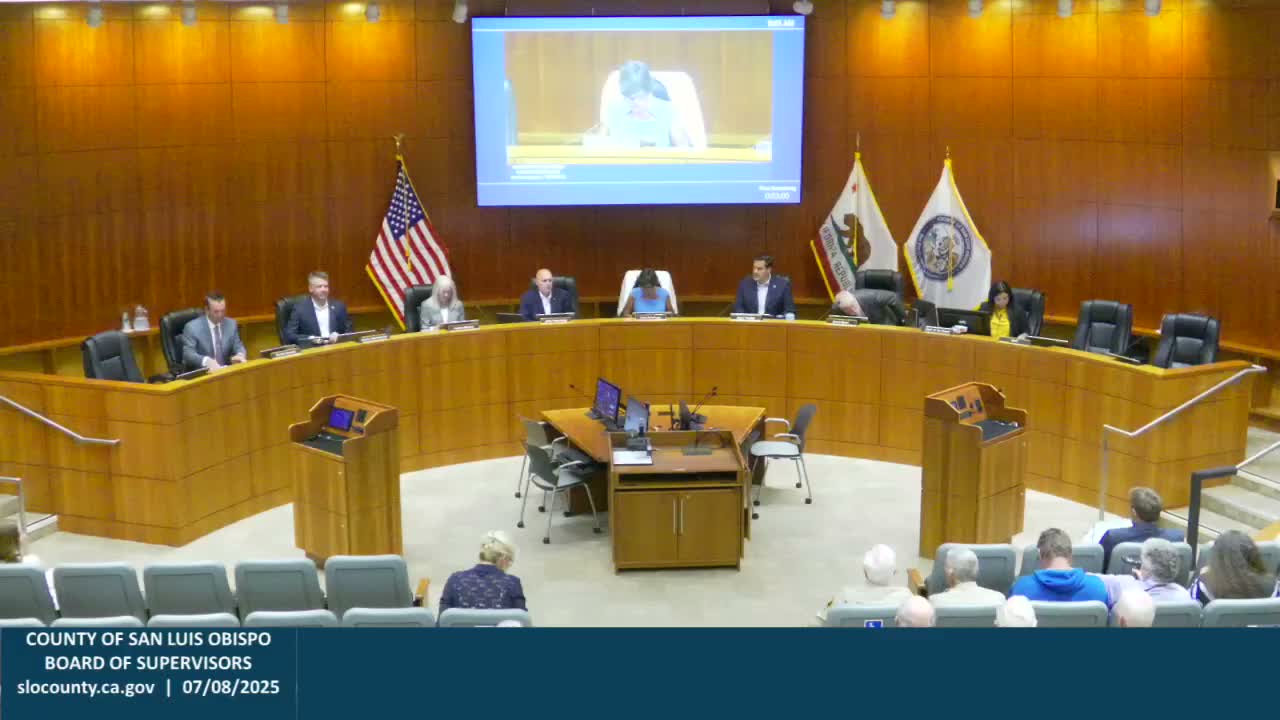
The San Luis Obispo County Board of Supervisors introduced a county weed‑abatement ordinance during the July 8 meeting and scheduled a public hearing for Aug. 19, county staff said. The agenda addendum listed the ordinance and noted staff amended the subject line to state the item is exempt from CEQA.
In public comment, Patrick McGibney, a rural property owner near the Caliente Range, said his experience with Cal Fire informed his view that the state agency cannot enforce abatement on private property and that a county ordinance is needed to compel cleanup in hazardous areas. "Cal Fire doesn't have the authority to enforce abatement... The county needs an abatement ordinance," he told the board.
Supervisors encouraged residents to participate at the Aug. 19 hearing. Several board members spoke in favor of bringing the ordinance forward. Supervisor comments noted prior conversations with fire captains and that the absence of an abatement ordinance had limited the county’s ability to require vegetation management in some unincorporated areas.
The board added a sentence to a letter to the California State Fire Marshal expressing concern about the lack of public input during fire‑severity mapping and noted they would pursue public engagement as part of the ordinance process.
Next steps: The ordinance remains at introduction; staff will return the item for a public hearing on Aug. 19, where the board will consider adopting the ordinance and any CEQA-related findings.