Get Full Government Meeting Transcripts, Videos, & Alerts Forever!
Get email alerts on the Water Policy topic
No spam. Unsubscribe anytime.
County adopts updated state water transfer policies to better manage 25,000‑acre‑foot allocation
Summary
The San Luis Obispo County Board of Supervisors unanimously approved updated policies to modernize management of the county’s 25,000‑acre‑foot state water allocation, including a proposed 5,000‑acre‑foot reliability reserve, prioritization rules that protect subcontractors' rights, and a timeline to solicit local water requests and negotiate contract changes.
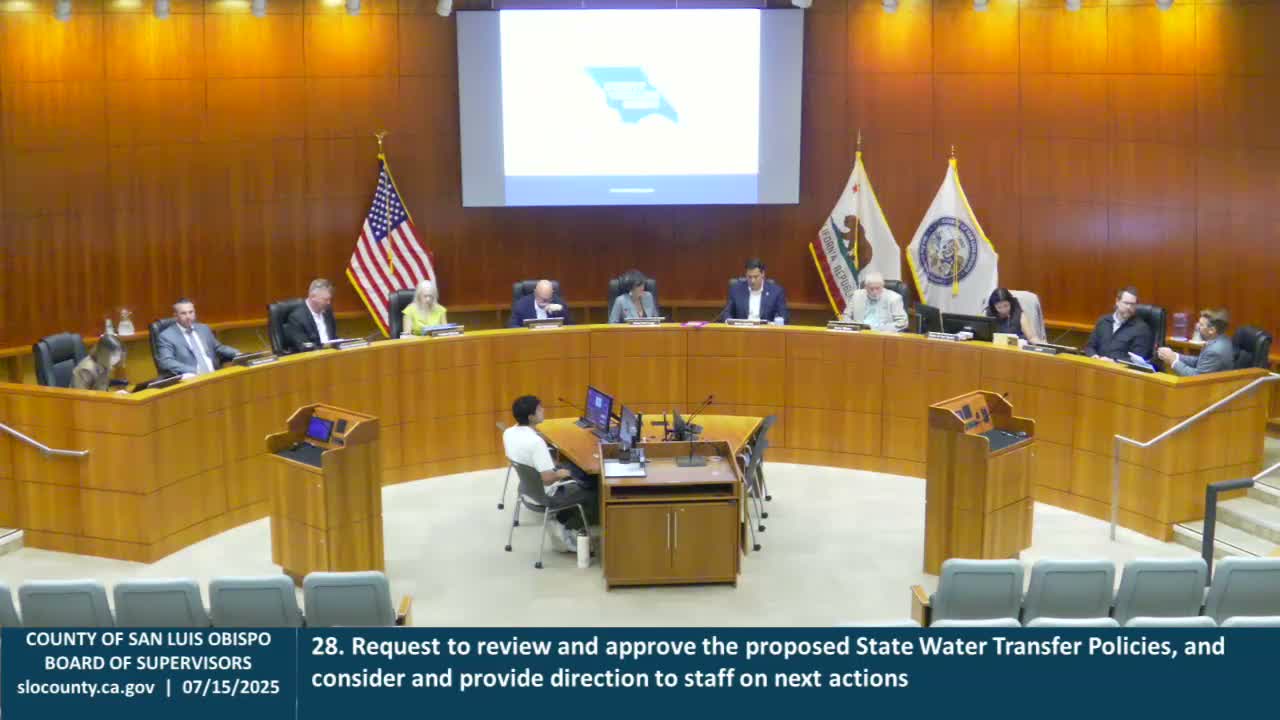
The San Luis Obispo County Board of Supervisors unanimously approved updated state water transfer policies intended to help the county make fuller and more equitable use of its 25,000‑acre‑foot state water allocation.
Public Works Director John Diodati and Supervising Engineer Wes Thompson told the board the current policy is more than 20 years old and no longer well suited to today’s variable hydrology and limited delivery capacity. Staff proposed a framework that preserves subcontractor rights, establishes a recommended 5,000‑acre‑foot reliability reserve, clarifies priority rules for surplus deliveries, and authorizes staff to pursue contract updates, solicit local requests and develop administrative procedures for transfers and exchanges.
Key elements: The policy package emphasizes that state water is primarily a supplemental supply and recommends a multi‑step prioritization for surplus water: first, subcontractor use; second, urgent local needs and emergency response; third, municipal/domestic uses; fourth, agricultural users; and last, non‑domestic requests. Staff said pipeline and turnout capacity currently limit deliverability — county staff noted roughly 4,830 acre‑feet of practical delivery capacity on the system — and that contract updates will be needed to enable storage, transfer and exchange options.
Staff timeline and next steps: Wes Thompson said staff plans to solicit requests from local agencies and stakeholders within the next 6–12 months and expects contract renegotiations with subcontractors may take two to three years to complete. The policies also ask staff to protect subcontractor investments by ensuring cost recovery for use of existing infrastructure when transfers are arranged.
Local reaction and rationale: Representatives of multiple local water agencies and mutual water companies told the board they supported the draft policies as a pragmatic starting point to maximize beneficial use, improve resiliency and recover infrastructure value. John Diodati described the approach as a way to "adapt to the variable hydrology and limited storage" while preserving board discretion for future decisions. Wes Thompson highlighted that the policies "prioritize" subcontractors' first right to surplus water under existing agreements, while creating a path to bring new users into the system under clear financial terms.
Board action: After questions and discussion about priorities, delivery capacity, and how Shandon’s small allocation could be used, the board voted unanimously to adopt the proposed policies and direct staff to update subcontract agreements, solicit requests, collaborate with subcontractors and return with procedures and agreements to implement approved transfers.
What to watch: Staff will begin outreach to local agencies and subcontractors and return to the board with specific contract language and recommended procedures. Any permanent transfers or exportation of water outside the county will still require compliance with applicable county ordinances and findings.