Get Full Government Meeting Transcripts, Videos, & Alerts Forever!
Get email alerts on the Lgbtq Health topic
No spam. Unsubscribe anytime.
County health staff report rising anti‑LGBTQ incidents and gaps in services and data
Summary
Deputy public health officials told supervisors that LGBTQIA+ residents in Alameda County face higher poverty, housing insecurity and mental‑health risks, and that anti‑LGBTQ hate crimes increased sharply between 2022 and 2023; the department urged standardized SOGI data collection and protections in county contracts.
Deputy Public Health Director George Ayala and county health staff presented the Board Health Committee with historical context and county findings on LGBTQIA+ health on Nov. 25, outlining disparities in poverty, housing insecurity, mental health, and a recent increase in anti‑LGBTQ hate crimes.
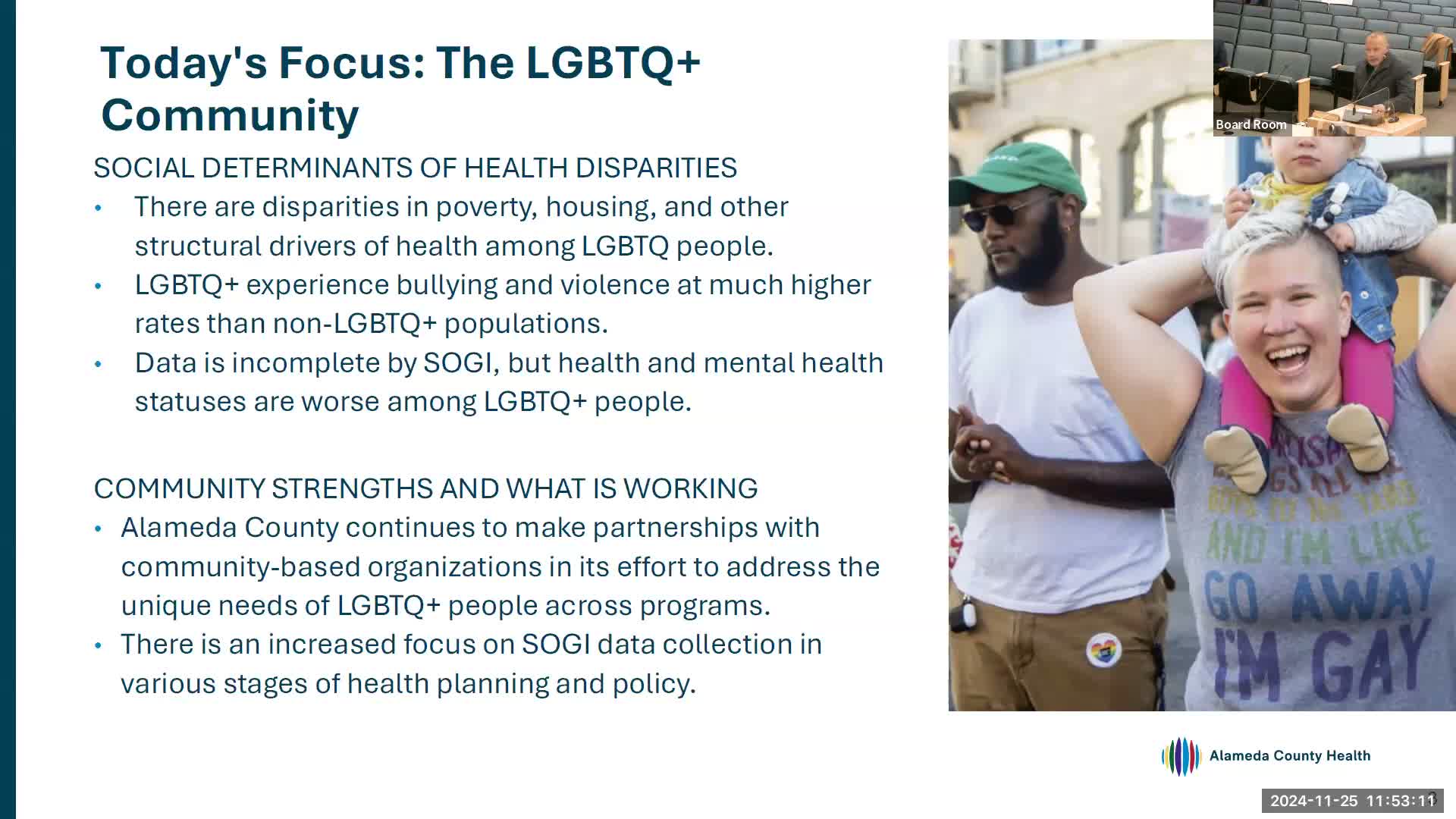
Ayala framed the presentation by tracing 20th‑century exclusion and later organizing, noting local history and community institutions while stressing that structural homophobia and transphobia continue to drive health disparities. "LGBTQ+ people experience bullying and violence at much higher rates than non‑LGBTQ+ populations," Ayala said, and he flagged intersectional disparities affecting people of color and transgender older adults.
Slides presented county and school survey figures: Ayala summarized age and identity breakdowns — the presentation cited roughly 14 percent of adults and 18 percent of high‑school students in Alameda County identifying as LGBTQIA+ (with slides listing adult bisexual identification at 6.9% and a transgender adult share around 1.28%).
The department highlighted mental‑health and youth suicide indicators reported in local and national surveillance: transgender and LGB youth were shown to be multiple times more likely to report suicidal ideation or attempts relative to cisgender straight students, and protective factors such as Gay–Straight Alliances were associated with reduced risk.
Public health staff also reviewed infectious‑disease prevention: the county has seen large declines in HIV mortality (a 75 percent reduction since 2005) and has scaled up PrEP (more than 2,500 county PrEP users reported in 2022 excluding Kaiser), but racial and ethnic gaps in PrEP uptake persist. The presenters noted that between 2022 and 2023 there was an increase in anti‑LGBTQ hate crimes with 58 incidents reported in 2023.
County recommendations emphasized standardized SOGI (sexual orientation and gender identity) data collection across county programs, continued investments in culturally affirming behavioral‑health and housing services, contract language to protect LGBTQ individuals and clear county communications to limit disruptions if federal policy changes affect access to gender‑affirming care.
Community partners presented program examples: the Oakland LGBTQ Community Center detailed bilingual and comprehensive services and alleged past bias in county grant decisions; Bay Area Community Health and TransVizion described gender‑affirming clinics and prevention outreach; La Clinica de la Raza highlighted Spanish‑language testing and linkage programs for Latinx communities.
Supervisors asked about the length of the county’s data series and how state work on SOGI data collection (a California Health work group with a draft rollout in 2025 noted by staff) will interact with local efforts. No formal board action was taken at the session.
The county has asked staff to continue work on SOGI data standardization, evaluate current contract safeguards, and identify investments to sustain HIV prevention, behavioral health and housing services for LGBTQ residents.