Get Full Government Meeting Transcripts, Videos, & Alerts Forever!
Get email alerts on the Housing Policy topic
No spam. Unsubscribe anytime.
Montgomery County unveils 'More Housing Now' workforce-housing package
Summary
Council members introduced the 'More Housing Now' package to expand housing along transit corridors, fund workforce housing, speed office-to-residential conversions, and double a homeownership fund; unions, teachers and nonprofits urged swift implementation at a press briefing and public comment session.
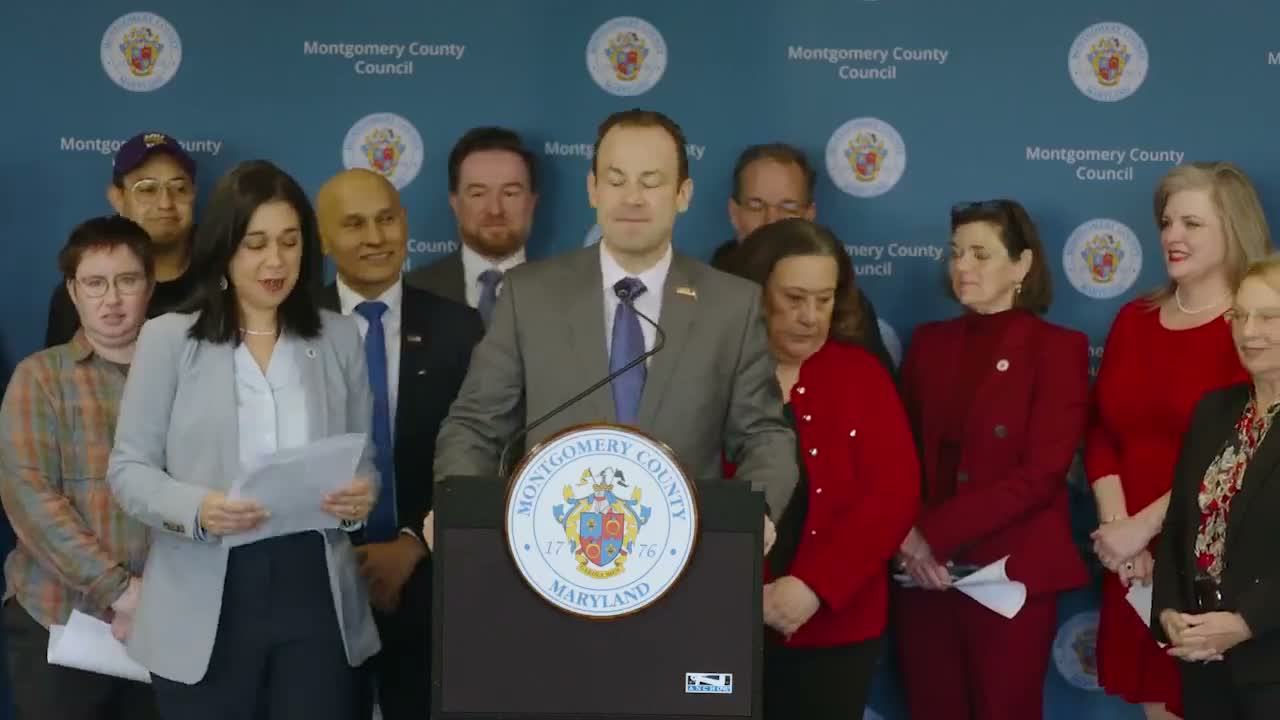
A Montgomery County council member unveiled the "More Housing Now" workforce-housing package onstage at a county press event, saying the county must act as home prices climb and businesses struggle to recruit staff.
The council member (the event's presenter) said the average detached home price in Montgomery County now exceeds $1,000,000 and said — using the figure cited at the briefing — a household would need roughly $340,000 in income to approach affordability under current market conditions. To respond, the package would: require a 15% workforce-housing component for new residential development along growth corridors via a zoning text amendment (ZTA); establish a $4,000,000 workforce housing opportunity fund to incentivize developers; expedite conversion of vacant office buildings into housing; provide a 25-year property-tax abatement to encourage conversions of office buildings that are more than 50% vacant; and double a county homeownership assistance fund from $4,000,000 to $8,000,000.
"More Housing Now is the most significant workforce housing proposal that the county has ever put forward," the council member said, framing the package as the result of months of outreach and a response to residents and housing experts.
Council member Natalie Fani Gonzalez, chair of the Economic Development Committee and a co-sponsor, said the package pursues "housing justice" by making it easier to build duplexes, triplexes and small apartments on corridors and by converting underused commercial space into homes. "We must build more housing for our workforce — I'm talking about teachers, firefighters, police officers, clerks," Gonzalez said.
Public commenters at the briefing described the local impacts the package aims to address. Elizabeth Meyer, a special-education teacher, said it is "nearly impossible" for many teachers to afford a home in the county and urged rules that permit a broader variety of housing types near transit and jobs. Thomas Courtney, vice president of the Montgomery County Career Firefighters Association (IAFF Local 1664), called the plan "the most comprehensive we have ever seen" and said firefighters also cannot afford to live in the county. Registered nurse Christopher Vroom described staffing problems tied to housing shortages, saying nurses have moved farther away and that some facilities have struggled to fill shifts; he added that, in his account, homelessness rose "over 40% in 2023 and almost 30% in 2024." CASA organizer Alex Vasquez and Jeff Dee of Habitat for Humanity endorsed the package and the proposed workforce fund as steps to expand housing and homeownership opportunities.
Montgomery Housing Partnership president Robert Goldman described a recent MHP project in which a 70-unit building on Georgia Avenue was upzoned to 189 homes near Forest Glen Metro and reported more than 600 people on the interest list for those units, arguing that corridor-focused zoning and office conversions are necessary to scale production.
Several council cosponsors endorsed the package onstage. Council President Kate Stewart and council members Dawn Lukey, Marilyn Balcom and Lori Ann Sales praised the effort as incremental but comprehensive, with Balcom singling out the office-to-residential conversion incentives as costly but essential and Sales noting the package's focus on workforce housing and the planned expansion of the homeownership fund. The presenting council member said two ZTAs included in the package will go to public hearing, giving residents a formal opportunity to comment.
When a reporter asked how this package differs from prior attainable-housing strategies and whether single-family neighborhoods were at risk, the presenting council member and Gonzalez emphasized the corridor focus: "The zoning change along the corridors to allow greater diversity of housing types where they are most likely to be built and where they are most needed," the presenter said, adding that the package is intended to target areas with proximity to jobs and amenities rather than single-family blocks.
Next steps: the council said the two ZTAs will undergo public hearings and further committee review; supporters and partners onstage urged rapid action and continued stakeholder engagement. The council did not announce votes or implementation timelines at the briefing.