Get Full Government Meeting Transcripts, Videos, & Alerts Forever!
Get email alerts on the Public Comment Policy topic
No spam. Unsubscribe anytime.
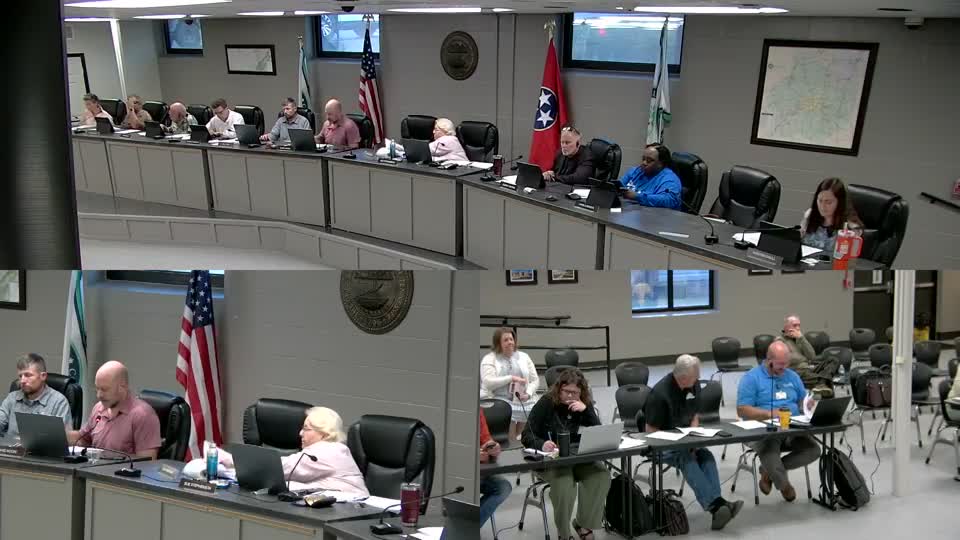
Maury County school board delays final vote as members debate new public-comment rules
Summary
At a work session April 21, the Maury County Board of Education debated edits to Policy 1.404 after a state law change requires local governing bodies to allow public comment on matters germane to their jurisdiction, whether or not on the agenda. Members disagreed over 5-minute limits, delegations and whether work sessions should include public comment.
The Maury County Board of Education spent most of its April 21 work session debating revisions to Policy 1.404, the district's rule on appeals and appearances before the board, after a recent update to state law requires local boards to provide a public-comment period that covers matters germane to the board's jurisdiction even if they are not listed on the meeting agenda.
Legal staff summarized the statutory change and told members the single substantive change in the law replaces the former requirement that comments be germane only to agenda items with a broader standard: comments may be germane to any matter within the board's jurisdiction. "The only thing that changed in the statute is subsection A," said the staff member advising the board. "It replaces 'germane to the agenda item' with 'germane to the jurisdiction of the body.'" (Legal counsel was present and provided the statutory interpretation during the work session.)
Several board members said the district's written policy needed updates, but they sharply disagreed about details. Member Stevenson said she was "very concerned about limiting this to 5 minutes," describing situations where parents appealing disciplinary or DHA (disciplinary hearing) matters might need more time or want to bring an advocate. Multiple members echoed concerns about whether a single five-minute cap for all appearances would be adequate for complex appeals.
Other questions focused on delegations and how to manage large crowds. Some trustees favored allowing a small number of spokespeople to present for a group; others said delegations should be required to choose multiple brief speakers or use a single spokesperson to keep meetings manageable. One member recommended a cap on total public-comment time for a meeting (for example, a 30-minute cap divided among speakers) while retaining the option to extend time by a majority vote.
Board members also debated whether to allow public comment at work sessions. Legal counsel explained that the statute's exception for meetings "for which there are no actionable items" may not prohibit public comment at work sessions; if the board allows comment at a work session, the board would be bound by whatever policy it adopts for that meeting type because a work session typically lacks formal voting authority. Members asked for more time to consider whether work-session comment should be permitted.
Several trustees said they favored retaining neutral time, place and manner rules (a per-speaker limit, order of speakers, and a cap on total time) but wanted an explicit carve-out for administrative appeals tied to disciplinary hearings, which may need a different process. Legal staff suggested moving complex appeal procedures into the DHA appeal policy and clarifying the public-appearance policy for general public comment.
After extended discussion, the board did not adopt final language. The chair said the packet would be revised and the policy would return for further review at the next work session; in the meantime, staff will distribute alternative language and members were invited to submit edits. "We will move this to the next work session," the chair said, and asked members to provide suggested changes to staff.
What remains: the board must decide whether to set a flat per-speaker maximum (the draft suggested five minutes), whether to allow multiple delegates or require a single spokesperson for group appearances, how to treat appeals tied to disciplinary hearings differently from general public comment, and whether to permit public comment at work sessions. Legal counsel advised that time, place, and manner restrictions consistent with First Amendment jurisprudence are permissible, but that the district must allow comment on matters germane to the board's jurisdiction regardless of whether the item appears on the agenda.
The board will reconvene the policy discussion at its next scheduled work session with revised drafts and additional staff recommendations.