Get AI Briefings, Transcripts & Alerts on Local & National Government Meetings — Forever.
Senate committee packages 19-article supplemental finance bill, adopts series of targeted amendments
Summary
The Senate Finance Committee on May 1 packaged House File 24-33 into a 19-article supplemental finance bill, adopted amendments to permit selected school fund transfers, clarify literacy aid calculations, allow DNR law-enforcement transfers, and add several targeted appropriations and technical fixes. The committee recommended the bill to pass.
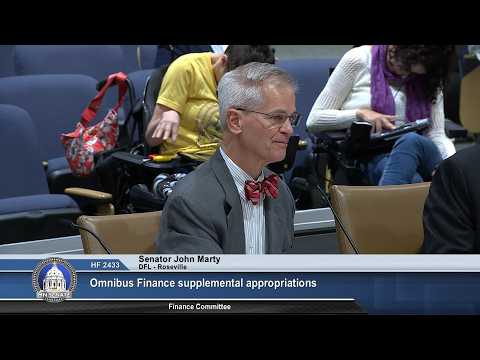
The Minnesota Senate Finance Committee on May 1 moved House File 24-33, a supplemental finance bill composed of 19 articles, and recommended it to pass after adopting a series of amendments. Senator Marty, the bill's chief author, said the A26 amendment in members' packets consolidates work the committee previously adopted article-by-article.
Committee staff member Miss Stengel walked members through the articles, which pull language from bills on education, higher education, agriculture, environment and natural resources, energy, jobs and economic development, labor, state government and other topics. "This comprises the work of all of the things that we have been amending into the supplemental budget vehicle," Miss Stengel said.
On education, the committee adopted the A73 amendment to permit four school districts (Ivanhoe, Maple Lake, Moorhead and West St. Paul) to transfer local fund balances into operating or other accounts. "These are four different fund transfers that have been requested by these schools anywhere from $68,000 to $4,500,000," Senator Kunish said, adding districts had vetted the requests and held public meetings. Senator Pratt questioned whether bond or LTFM (long-term facilities maintenance) proceeds could be moved to general operating funds without voter approval; nonpartisan counsel and Mr. Arneson explained that in these cases the proceeds were excess LTFM/block-construction funds and that statutes allow transfers subject to local board approval and existing authorized uses.
The committee also adopted the A88 amendment directing the Department of Education to exclude certain assessments from literacy incentive aid growth calculations amid MCA changes and widespread test opt-outs; sponsor Senator Kunish described the change as cost neutral and intended to avoid large swings in aid for districts.
Noncontroversial technical fixes were adopted for higher education (A82) and other articles; the committee adopted A77 to allow the Department of Natural Resources to transfer up to $1.6 million in carryforward appropriations to cover DNR enforcement costs that arose this year, with reporting to legislative chairs. Senators also approved A58 to permit a transfer/sale of surplus state park land in Mille Lacs County to address an urgent local cemetery need, and A57 to narrow the scope of an infectious-waste study so the MPCA can use a representative sample rather than attempt to enumerate every generator.
Other changes included removing a $100,000 appropriation from the jobs bill (A72), pausing a prevailing-wage portal provision (A90) to allow more technical work, and renaming the Veterans Service Building in honor of former Senator Bruce Anderson (A86). Senator Marty also carried A74 to adjust the new consumer enforcement fund cap and A96 to add $1 million to the Office of Justice Programs crime victims account; both were adopted.
After taking dozens of amendments across the articles, Senator Marty moved the bill as amended and the committee recommended it to pass and instructed staff to make technical and conforming changes, including correcting the bill title.
The committee recorded several roll calls on contested amendments earlier in the hearing (see Votes at a glance). The package passed committee with multiple bipartisan amendments that sponsors described as addressing urgent operational needs while keeping the vehicle focused on supplemental appropriations.
The committee adjourned with the bill recommended to pass and staff directed to prepare the engrossed version for floor consideration.