Get Full Government Meeting Transcripts, Videos, & Alerts Forever!
Get email alerts on the Bridge Finance topic
No spam. Unsubscribe anytime.
Laredo finance staff present bridge-rate study; proposed phased increases prompt industry and council scrutiny
Summary
City finance staff presented a system-wide bridge toll-rate study that recommends phased toll increases to restore purchasing power, cover operations and finance $225 million in bridge expansions. Trucking industry and several council members urged more granular, per-truck metrics and competitor comparisons before any decision.
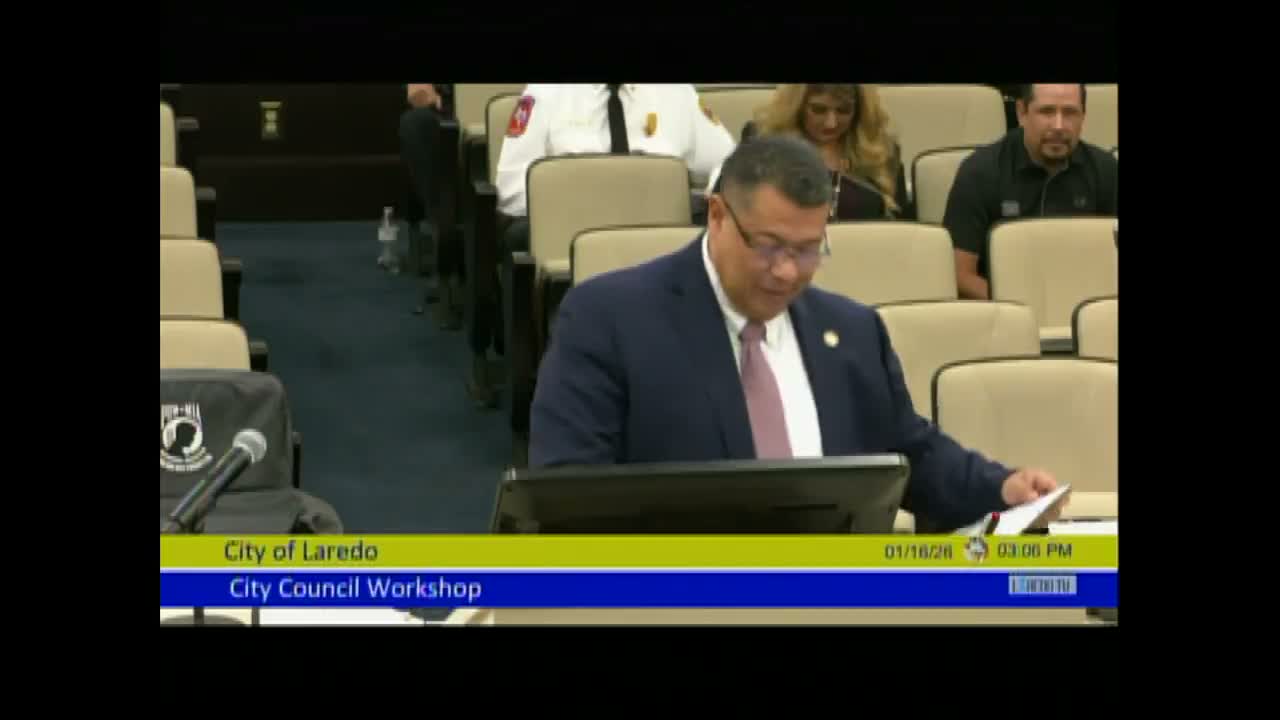
City finance staff presented a comprehensive toll-rate study at the Jan. 16 workshop that examined toll sufficiency, compliance with an existing transfer policy (Resolution 98-R-164), and a policy framework to allocate a proportional share of city service costs to bridge users.
Travis Tomata, director of finance, told the council the bridge system met the technical flow-of-funds requirements for fiscal years 2021–2025 but argued the established transfer formula does not reflect current vehicle-volume-driven demands on police, fire, streets and traffic operations. The study combines traffic counts, toll history, vehicle registration and departmental workload data to estimate a proportional share of general-fund services attributable to bridge traffic.
Staff said static nominal tolls since 2013 (noncommercial) and 2017 (commercial) have eroded in real value; the study models CPI-based adjustments and a multiyear, phased approach intended to restore purchasing power, support $225 million identified capital needs (including World Trade Bridge and Columbia Bridge expansions) and preserve the bridge enterprise’s credit strength. Staff emphasized a phased rollout to avoid steep, single-year spikes and proposed implementation timing that would allow industry contract adjustments (decision by March; implementation in September–October).
Industry representatives and council members pressed staff on several technical points: how the city attributed road wear and service costs to nonlocal commercial vehicles, why certain sampling and allocation assumptions were chosen, and whether a simpler CPI-correction approach or different per-bridge rates should be considered. Jerry Maldonado, chair of the Laredo Motor Carriers Association, warned that market conditions and recent declines in full truckloads make carriers sensitive to large toll hikes. Council members asked staff to provide per-truck, per-5-axle cost tables and competitor rate histories to show the city’s competitiveness regionally.
City staff said the study is the beginning of a process: they will share the full report and slides with port authority staff and the industry, host follow-up briefings and return to council with refined scenarios and corrected tables to support council decisions. No vote occurred at the workshop.