Get Full Government Meeting Transcripts, Videos, & Alerts Forever!
Get email alerts on the Public Opinion topic
No spam. Unsubscribe anytime.
City poll: 51% of respondents prefer no new barrier; dual-purpose flood wall favored over traditional steel barrier
Summary
A city-commissioned representative poll of 715 residents found roughly half prefer no new barrier; among those who favor some measure, a dual-purpose flood-and-security wall ranked higher than a traditional steel or concrete wall. Majorities opposed eminent domain for private land.
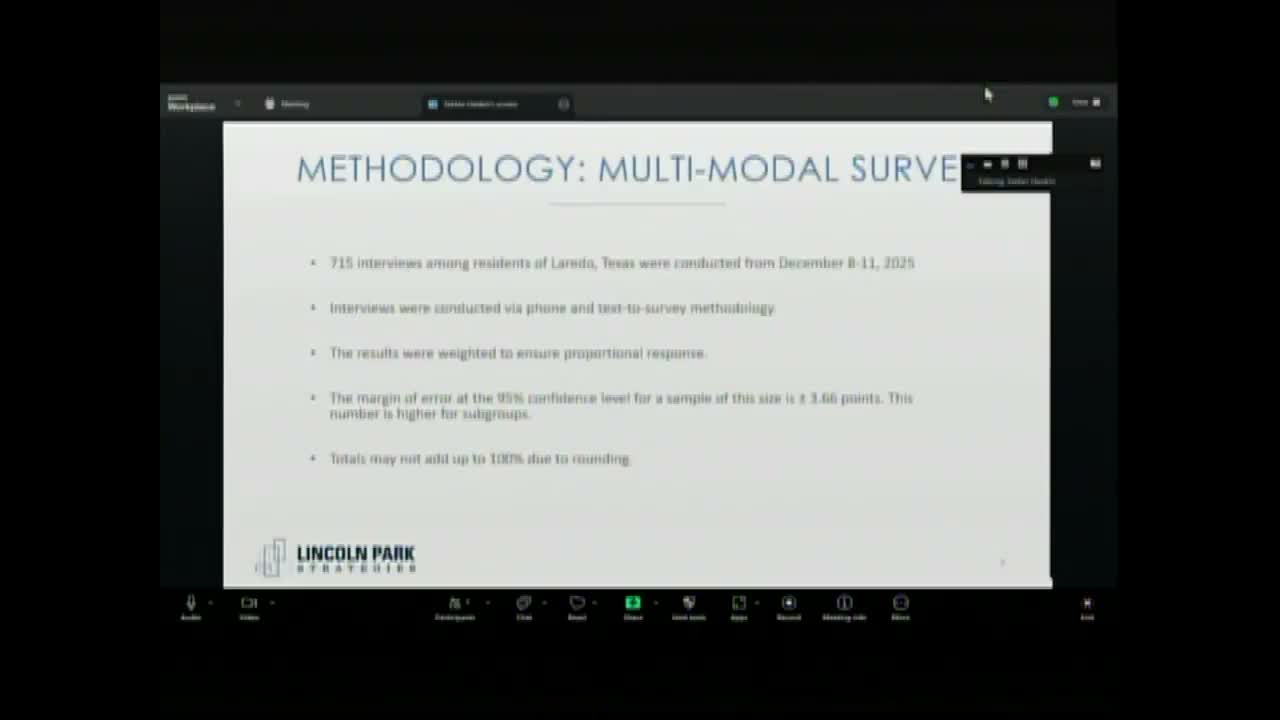
The city’s consultant presented results from a two-phase poll at the Jan. 16 workshop: a representative multimodal poll (715 completes; margin of error about ±3.7 percentage points) and a public web survey (249 completes).
The consultant summarized that, when asked to rank options if new barriers were built, 50–51% of respondents selected “no new barrier” as their first choice, about 30% chose a dual-purpose flood wall that also provides security, and roughly 19% chose a conventional steel or concrete wall. Among respondents who said additional measures were needed, dual-purpose designs tended to be favored over traditional walls.
On governance questions, 43% said the city alone should lead design decisions while 39% preferred a joint city–federal process. The poll found majority opposition to the federal government using eminent domain to acquire private land for wall construction (about 52% opposed for private land; similar opposition appeared for city land), and strong support for structures that meet FEMA and International Boundary and Water Commission standards.
The consultant explained methodology and defended the sample size, noting the representative poll used multimodal contact (text, live calls and landlines) and bilingual interviewers; the public link allowed additional feedback but was subject to self-selection bias. Council members pressed on the poll’s representativeness given the city’s larger voting population and asked whether the meaning of “eminent domain” had been explained to respondents; staff confirmed the survey did not define that legal term in-field, and the city attorney later gave a plain-language explanation during Q&A.
City staff and several council members requested follow-up materials including question wording, raw cross-tabs by council district and methodology appendices. Staff corrected and clarified the vendor cost for the representative poll during the meeting (consultant's corrected figure: $29,400).