Get Full Government Meeting Transcripts, Videos, & Alerts Forever!
Get email alerts on the Land Use Replat topic
No spam. Unsubscribe anytime.
Commissioners deadlock 2‑2 after closed‑session review of Cope 2 replat
Summary
After a public hearing and a closed‑session review, Collin County Commissioners Court failed to approve a replat of Lot 24 in the Cope 2 Addition on a 2‑2 vote. County staff said the replat would create an emergency access easement; an attorney argued state law makes approval ministerial.
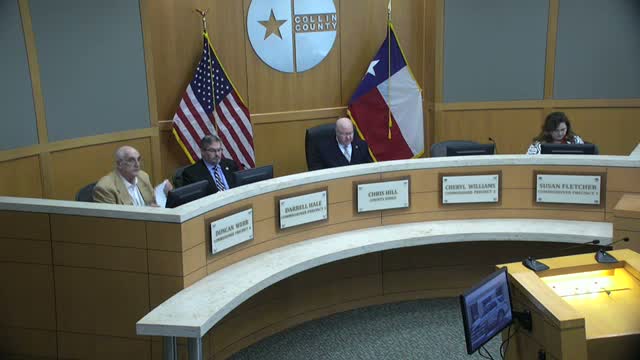
A split Collin County Commissioners Court failed to approve a replat of Lot 24 in the Cope 2 Addition after sending the item to a closed‑session legal review and returning to open session with a 2‑2 vote.
Tracy Homfeld, with county engineering, told the court the replat would establish a roadway easement to provide a secondary emergency access to a proposed development to the north and said staff had reviewed the submission for compliance with Texas Local Government Code Section 232.009. "We respectfully request that the court open the public hearing to receive testimony regarding the proposed replat," Homfeld said during the public hearing.
Kyle Verla, representing First Step Homes and the developer P12, said the proposed gate along the shared boundary would remain closed and serve emergency ingress and egress only. "We don't want any extra traffic due to this development," Verla said, adding the access would bring the development closer to current fire code by providing a required second emergency entrance.
Leonard Smith, an attorney with the Pope Hardwick Law Firm who spoke on behalf of a party that had submitted opposition materials, told the court the statute governing plats leaves the county with a ministerial duty when an application complies with subdivision rules. "The statute in question... makes that the case for you using the words ‘shall approve,’" Smith said, arguing the court’s discretion is limited when the filing meets the code's requirements.
After questions about whether acceptance of the easement could create an adverse‑effect determination and a request to confer with county counsel, the court recessed to executive session for legal consultation. After returning to open session, the judge announced the prior motion to approve was put to a vote and failed 2‑2.
The court did not adopt the replat and took no further action on the item at adjournment. Staff noted an opportunity for administrative remedies and for parties to pursue complaints under local rules; the court said the item may be revisited when legal clarity is available.