Get Full Government Meeting Transcripts, Videos, & Alerts Forever!
Get email alerts on the Audit Policy Conflict topic
No spam. Unsubscribe anytime.
Collin County auditors and tax assessor clash over cash-handling policy as commissioners urge a settlement
Summary
Commissioners probed a recurring compliance audit after the tax assessor-collector described operational constraints that prevent daily check deposits. The county auditor cited state law requiring the auditor to prescribe accounting controls; both offices were urged to meet and reconcile procedures.
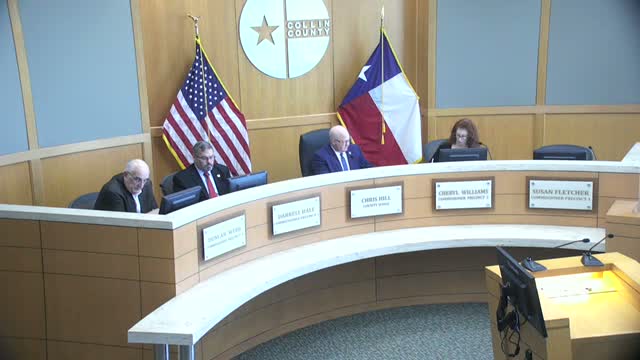
Collin County commissioners pressed the tax assessor-collector and the county auditor on conflicting cash-handling practices at a court meeting where officials warned unresolved differences could recur on future agendas. The dispute centers on whether the county auditor’s internal controls require the assessor to receive, log and deposit checks immediately upon opening mail.
Commissioner Webb said the auditor’s quarterly compliance report portrays the assessor as refusing to follow county policies, noting the auditor’s write-up “said, ‘I follow my own policies. I don’t follow the auditor’s policies.’” The remark framed the item the court had pulled for discussion.
County Auditor Cohen told the court the local government code gives the auditor authority to prescribe county accounting systems and internal controls. He said the relevant provision makes the auditor responsible for those processes and for carrying out compliance audits. “Section 113.064 of the local government code mandates that the auditor set forth and prescribe the accounting system,” Cohen said, and he described the policy language requiring checks to be receipted, logged, endorsed and either secured or deposited promptly.
Tax Assessor-Collector Scott Griggs said he had not refused to follow auditors’ policies but that office operations and high volumes of mailed payments make same-day deposits impractical. “At no point did I say that I was not going to follow the auditor’s policy; this is a specific operational issue when it comes to the volume of checks that I receive,” Griggs said. He described processing backlogs during peak periods and told the court his office had been as much as three months behind at the time he took office; during normal cycles the office aims to process motor-vehicle work within about two weeks and titles within about a month.
Griggs told commissioners he would need “at least” dozens of additional staff to meet a same-day-deposit standard during peak season. He said he had requested nine additional desk positions in the budget and that his larger estimate of 50 staff would be to handle peak loads. The assessor’s office also has shifted some processing off-site and said it secures unopened mail and places counts and receipts under locked controls.
Judge Hill and other commissioners pressed for specifics about overtime and comp-time use to keep lag time steady. Griggs said comp time and short lunches were among the measures the office used to meet demand and that recent hiring had reduced vacancy levels but had not eliminated cyclical delays.
Cohen said the auditor’s written policy requires immediate processing ‘‘upon opening and recognizing that there’s a check’’ and that the office’s practice includes receipting, logging, restrictive endorsement and securing or depositing funds without delay. He described a proposed alternative policy Griggs had sought as too open-ended to be accepted without further revision.
The court urged the two offices to meet and reconcile their operational procedures to avoid repeated agenda items. Judge Hill said the court would continue to raise the issue in public session until it was resolved. The court then approved acceptance of the compliance audit paperwork (time and place acceptance) by unanimous vote, while directing staff and elected officials to confer afterward to agree on workable controls.
What happens next: county staff and the assessor’s office were asked to sit down with the auditor to identify operational amendments or documented exceptions that could be adopted into the auditor’s control framework. The court indicated it would monitor the outcome and return the topic to a future docket if necessary.